
PPOR Meaning: Principal Place of Residence Guide
PPOR meaning explained: how your principal place of residence affects CGT, land tax and stamp duty in Australia — plus the rules most investors miss.
 Jonathan Zuvela
PPOR Meaning in Australia: Principal Place of Residence Guide
Your PPOR status is worth hundreds of thousands of dollars. The capital gains tax main residence exemption alone can wipe out a $400,000 CGT bill when you sell the family home, the property that has been home to your family for years. Land tax exemptions can also apply in situations where a family member, such as a spouse or dependent, resides in the property or contributes to expenses, as recognized by state rules, and every state throws in a land tax exemption on top. Yet most Australians could not tell you exactly what their principal place of residence means or which rules apply when these taxes are assessed. For a practical next step, read our guide to buying an investment property in Australia.
This guide fixes that. Whether you are buying your first home, moving between properties, or working out whether your former home still qualifies, the rules around your principal place of residence determine what taxes you pay and what you keep. With the 2025-26 tax year closing on 30 June and foreign resident rules tightening, getting this right matters more than ever for every residential property owner. For a practical next step, read our guide to buying an investment property in Australia.
What PPOR Actually Means
PPOR stands for principal place of residence. In Australia, the term PPOR is significant for tax and legal purposes, distinguishing a primary home from investment properties or holiday homes. In everyday language, it is the home you actually lived in as your primary address-also referred to as your 'primary residence' or 'principal residence' for tax purposes-the place where you sleep most nights, receive your mail, enrol the kids in school, and keep your personal possessions and personal belongings. In tax terms, your principal place of residence is the property the ATO has considered your main residence for capital gains tax purposes and the property your revenue office treats as exempt from state land taxes. For a practical next step, read our guide to buying an investment property in Australia.
Only one property at a time can qualify as your principal place of residence. You cannot use a rental in Brisbane and a holiday house in Byron Bay as your principal place at the same time. Each revenue office applies its own tests, but the concept is the same: the home you actually use as the centre of your life, the place you lived in to sleep, eat, and keep what matters to you. Qualifying residential accommodation includes a house, strata title unit, mobile home, or retirement village unit. For a practical next step, read our guide to buying an investment property in Australia.
Importantly, PPR exemption (the short form used in some jurisdictions) and PPOR exemption describe the same idea. Different agencies just use different acronyms for the place you call home. For a practical next step, read our guide to buying an investment property in Australia.
Capital Gains Tax and Your PPOR
When selling a PPOR, it is generally exempt from Capital Gains Tax (CGT) if the property was not used to produce income. The capital gains tax main residence exemption (also known as the CGT main residence exemption) is the biggest of all the property taxes concessions most Australians ever receive. If a dwelling qualifies as your main residence for the full period you owned it, you pay no CGT when you sell - regardless of how much the property has grown in value, and regardless of the taxes that would otherwise apply. For a practical next step, read our guide to buying an investment property in Australia.
Consider a Melbourne couple who bought their home for $650,000 in 2015 and lived there for ten years before selling for $1.25 million in 2026. Without principal place of residence eligibility, that $600,000 capital gain could trigger a CGT bill of roughly $140,000 after the 50% discount. With the main residence exemption, the entire profit is exempt and they keep every dollar they earned on the sale of their home. The net capital gain reported on your tax return is reduced by the main residence exemption, lowering your overall tax liability. For a practical next step, read our guide to buying an investment property in Australia.
To claim the exemption, the dwelling must have been your home for the entire ownership period. Partial exemption, known as a partial main residence exemption, applies if you only lived there for part of the time or used part of the home to produce income. The ATO sets out the eligibility for the main residence exemption in detail, and our capital gains tax calculator shows exactly how the partial exemption is apportioned when rules like the 6-year absence rule come into play. For a practical next step, read our guide to buying an investment property in Australia.
 For a practical next step, read our guide to buying an investment property in Australia.
Worked Example: Full vs Partial Exemption
A Sydney owner bought a unit in 2018 for $700,000 and lived there for three years before renting it to tenants for two years, then selling in 2026 for $1.05 million. The profit is $350,000. Because they lived in the unit for three of the five years owned, the main residence exemption applies to that proportion. Roughly 60% of the capital gain is exempt, 40% is taxable, and the 50% CGT discount then applies on top. The net result: taxable gain near $70,000 instead of the full $350,000 - a concrete example of how this rule can slash the taxes you owe. The owner must report the capital gain and any rental income derived from the property on their tax return. For a practical next step, read our guide to buying an investment property in Australia.
Land Tax and Your PPOR
Most Australian states and territories offer exemptions from land tax for a property classified as a PPOR. Every Australian state charges land tax on investment properties above a threshold, and every one of them offers a land tax exemption for your principal place of residence. Landowners are required to pay land tax each land tax year unless an exemption applies. This is the second major concession your principal place earns you in the Australian taxes system, and in most cases it applies automatically once the property is considered your home by the relevant revenue office. For a practical next step, read our guide to buying an investment property in Australia.
A $900,000 Sydney investment property could attract around $4,500 a year in land tax. Change that same property to your principal place of residence and the liability drops to zero. Multiply that over a decade of ownership and the exemption saves you roughly $50,000 for each land tax year the exemption is in place - enough to cover a deposit on the next property. Put another way, the land taxes this exemption removes often cover more than a year of mortgage repayments on the home itself. For a practical next step, read our guide to buying an investment property in Australia.
The details vary. Revenue NSW applies the principal place of residence exemption through self-declaration. Victoria requires you to notify the State Revenue Office if your status changes, per the published Victorian land tax exemptions rules (the Victorian land tax exemption applies to land owned by individuals who use it as their principal place of residence). Queensland's QLD land tax overview explains its home exemption separately for resident and absentee owners. Each office keeps its own register, so notifying one does not automatically update another. For a practical next step, read our guide to buying an investment property in Australia.
 For a practical next step, read our guide to buying an investment property in Australia.
Main Residence Exemption Eligibility: What Qualifies
The tax office does not apply a single hard-and-fast rule. Instead it weighs a list of factors to decide whether a dwelling is considered your main residence. No single factor is decisive on its own, and the relevant criteria are applied flexibly across different circumstances. However, specific occupancy requirements and the owner's intention to use the property as their principal residence are key factors. The exemption applies only if the property is used for residential purposes and is established as the owner's principal place of residence. For a practical next step, read our guide to buying an investment property in Australia.
Continuous Occupancy and Your Move-In Date
You must physically occupy the dwelling and establish it as your home. A handful of overnight stays while you finish a renovation will not cut it. The ATO looks for continuous occupancy starting from when the property became practically available to you - usually settlement or when the lease of the previous owner or tenant ended, provided you then intend to reside there as your home. For a practical next step, read our guide to buying an investment property in Australia.
The ATO's Key Tests
Several conditions help prove the property is your genuine main residence and that it should qualify for the exemption: For a practical next step, read our guide to buying an investment property in Australia.
-
The length of time you have lived there and how regularly you use the dwelling For a practical next step, read our guide to buying an investment property in Australia.
-
Your mailing address and driver's licence address For a practical next step, read our guide to buying an investment property in Australia.
-
The address on the electoral roll, with records from electoral roll services commonly accepted as documentation to verify your principal place of residence for compliance and proof of residency For a practical next step, read our guide to buying an investment property in Australia.
-
Where your personal possessions are kept, as this demonstrates the property is your main home For a practical next step, read our guide to buying an investment property in Australia.
-
Connection of utilities (electricity, gas, internet) in your name For a practical next step, read our guide to buying an investment property in Australia.
-
Your intention - was it always meant to be a home or was it bought as an investment For a practical next step, read our guide to buying an investment property in Australia.
-
Whether you treat the place as established in your life (GP, schools, community) For a practical next step, read our guide to buying an investment property in Australia.
Documents matter. The more paperwork showing the address is your primary home, the easier it is to demonstrate the property should be considered your principal place of residence if the tax office ever audits the claim. Keeping the information together - lease handovers, utility bills, bank statements - makes the case for you and helps meet the requirements in one place. For a practical next step, read our guide to buying an investment property in Australia.
Joint Owner Rules for Couples
When a property has more than one owner, each owner's entitlement to the main residence exemption is calculated separately, whether the property is jointly owned as tenants in common or as joint tenants. If you and your partner own a home together as joint owners and it is your home, each of you is entitled to claim 50% of the exemption on the capital gain. For a practical next step, read our guide to buying an investment property in Australia.
It becomes more complex where spouses lived separately or are separated. A married or de facto couple can only have one principal place of residence between them at any time, unless each partner nominates a different property. If they do, each will only qualify for half the main residence exemption for the period they nominated different homes. The exemption applies only if the property was the main residence for the whole period of ownership, unless otherwise specified; the main exception is the 6 months overlap. Nominating two separate PPORs rarely produces a better outcome than agreeing on one. For a practical next step, read our guide to buying an investment property in Australia.
Your Former Home and the 6-Year Rule
One of the most valuable conditions in the main residence exemption is the absence rule. After you move out, you can continue to treat your former home as your main residence for up to six years if you rented it to tenants, and indefinitely if you leave it vacant. If you rent out your primary residence, you must pay tax on the rental income you earn, which can affect your overall tax liability - though the PPOR CGT protection continues for up to six years of absence. This is commonly called the 6-year rule and it is set out in the ATO's 6-year absence rule guidance. This six year period is important for CGT exemption purposes. For a practical next step, read our guide to buying an investment property in Australia.
Each new absence period resets after you move back in and occupy the property again. The exemption can apply for the entire period of rental, provided the total rental periods do not exceed six years each time. A Brisbane owner who lived in their home for three years, rented it out for five while working overseas, moved back for a year and then rented it for another four could potentially sell entirely CGT-free. Each time they returned to occupy the dwelling, they reset the clock, and the property they owned continued to qualify for the exemption, known as the full CGT exemption under the six-year rule. For a practical next step, read our guide to buying an investment property in Australia.
The trade-off: while you are treating the former property as your principal place, you cannot also nominate a second home as your main residence. For a full walkthrough of the mechanics, see our complete guide to the capital gains tax 6 year rule. For a practical next step, read our guide to buying an investment property in Australia.
More Than One Property: Which Is Your PPOR?
Australians who own more than one property - say a house in Perth and a unit in Adelaide - can only claim one as their principal place at any given time. The ATO will look at where you actually lived during the relevant years and apply the eligibility factors above, based on objective evidence rather than on which property you would prefer to nominate. For a practical next step, read our guide to buying an investment property in Australia.
If you move between residences, you have a short overlap window. During a transition between properties, both an old and new home may be treated as a PPOR for up to six months. The ATO allows you to treat two properties as your main residence for up to six months when you are moving to a new main residence, provided the old home was your principal place of residence for the three months before that transition period and was not used to earn income during the overlap. This rule applies only if neither property is classified as other land not used for residential purposes. For a practical next step, read our guide to buying an investment property in Australia.
For portfolios tracked in PropBoss, you flag which property is the principal place of residence and the system handles the CGT apportionment automatically when you model a sale. For a practical next step, read our guide to buying an investment property in Australia.
Apartments, Units and Flats Qualify Too
The main residence exemption is not limited to a detached house. A unit, a townhouse, a flat, a duplex, a studio apartment, or a strata title unit can qualify. The same eligibility conditions apply: you must occupy the dwelling, use it as your home, and meet the tests discussed above. Strata fees and common-property arrangements do not affect the exemption. The test is whether the place you lived in was your genuine home, not the style of the residential building. For a practical next step, read our guide to buying an investment property in Australia.
For owners of multiple units in a single complex - for example, one flat occupied and another rented - only the flat actually considered the main residence qualifies for the exemption. A separate dwelling, such as a granny flat, does not qualify unless it is your main residence. The rented flat is a standard investment property for CGT purposes and remains subject to the usual taxes applied to rental income and capital gains. For a practical next step, read our guide to buying an investment property in Australia.
Using Part of Your Home for Business Purposes
Running a business from home is common, and it does not automatically destroy your principal place of residence status. It does, however, trigger partial CGT liability. If you use a dedicated room (say 12% of the floor area) exclusively for business and claim a deduction for occupancy expenses, then 12% of your future capital gain becomes taxable. Partial exemption applies if you only lived there for part of the time or used part of the home to produce income, including situations where you derive income from business activities conducted at home. For a practical next step, read our guide to buying an investment property in Australia.
The test is exclusive use. A home office that doubles as a guest room on weekends is generally not considered to trigger partial CGT. A dedicated consulting room, a hairdressing studio in the garage, or a commercial kitchen in a converted laundry typically does. Keep detailed records of the floor plan, the percentage used, and the dates the space was active - you will need that information when you eventually sell. For a practical next step, read our guide to buying an investment property in Australia.
Deceased Estates and PPOR
When a home passes through a deceased estate, the main residence exemption does not end immediately. The exemption continues for a period after the owner's death-generally, the executor or beneficiary has two years from the date of death to sell the dwelling without triggering CGT, and that period can be extended at the ATO's discretion in complex estates where legal or tenancy conditions delay matters. However, the exemption ends if the property is used to earn income or is no longer occupied by a natural person who has a right to reside, such as under a life estate granted by will or testamentary instrument. For a practical next step, read our guide to buying an investment property in Australia.
If the beneficiary moves into the dwelling and makes it their own main residence, a different rule applies: the home can continue to be treated as exempt for as long as the beneficiary occupies it. Trust arrangements add further complexity-rules differ for fixed trusts compared to discretionary trusts. Only a fixed trust may allow beneficiaries to claim the exemption if they use the property as their main residence. Where the dwelling is held by a trustee rather than directly by an individual, specialist advice is essential. Errors here can cost tens of thousands in avoidable taxes, and the documents needed to prove occupancy and intention are harder to reconstruct after the fact. For a practical next step, read our guide to buying an investment property in Australia.
Foreign Residents and PPOR
Since 2020, foreign residents have been largely locked out of the main residence exemption. If you are a non-resident for tax purposes on the day you sell an Australian dwelling, you generally cannot access the exemption at all - not even for the years you lived in the property as an Australian resident. This is a cliff-edge change, not a pro-rata one, and these rules are administered by the Australian Taxation Office. Many owners only discover it when the assessment arrives. For a practical next step, read our guide to buying an investment property in Australia.
There are narrow life-event exceptions: death of a spouse, terminal illness, divorce or separation within the prior 6 years. These are published in full on the ATO's foreign resident main residence rules page. A person who does not meet one of these exceptions pays CGT on the full gain at non-resident rates, with no discount granted. For a practical next step, read our guide to buying an investment property in Australia.
For Australians planning a period of work abroad, the practical takeaway is this: if you are likely to be a foreign resident on the date you sell, timing the sale before you leave or after you return can protect the exemption entirely. For a practical next step, read our guide to buying an investment property in Australia.
Home on More Than 2 Hectares
To qualify for the full CGT exemption, the land surrounding the PPOR must generally be two hectares or less. The main residence exemption covers your dwelling plus up to two hectares of adjacent land used primarily for private purposes. Adjoining land on a separate title may also qualify for exemption if it is used mainly for private purposes and not for income-producing activities. For a suburban block, the full garden falls comfortably within the limit. For a lifestyle block, a hobby farm, or a rural property with multiple lots, part of the gain can be taxable. For a practical next step, read our guide to buying an investment property in Australia.
You choose which two hectares receive the exemption, and the choice matters for high-growth parcels. The ATO's 2-hectare land limit page explains how the apportionment is calculated. The Valuer General may be involved in determining the split between personal and business use. When part of the land is used for income-producing activities - running cattle, agistment, or a farm stay - only the portion used for private purposes qualifies for the exemption. For a practical next step, read our guide to buying an investment property in Australia.
State-by-State Land Tax Exemption
The principal place of residence land tax exemption is offered by every Australian state and territory, but the thresholds, surcharge rules, and paperwork differ. A snapshot across the three largest: For a practical next step, read our guide to buying an investment property in Australia.
| State | Land tax threshold (2026) | PPOR exemption | Notes |
|---|---|---|---|
| NSW | $1,075,000 | Automatic once declared | Foreign owner surcharge 4% |
| VIC | $50,000 (individuals) | Must notify SRO | Absentee owner surcharge 4% |
| QLD | $600,000 (individuals) | Apply via OSR | No surcharge on home |
If you move interstate or convert the home you owned to a rental, notify the relevant revenue office promptly. Late notifications can trigger backdated assessments and penalties. PropBoss's land tax calculator shows your state-by-state liability for all the land taxes you might owe and flags when the PPOR exemption applies. You must pay tax on any land that does not qualify for the principal place of residence exemption. For a practical next step, read our guide to buying an investment property in Australia.
First Home Buyer Stamp Duty Concessions
First home buyers may qualify for grants or stamp duty concessions if the property they purchase is intended to be their PPOR. Every state also runs a first home buyer concession that relies on your intention to live in the dwelling as your principal place of residence. These concessions typically waive or reduce transfer duty for properties below a price cap, provided you move in within a set period (usually 12 months) and lived there for a minimum period (usually 6 or 12 months). For a practical next step, read our guide to buying an investment property in Australia.
If you move out early or rent the property from day one, the concession is granted on the condition of occupancy and can be clawed back. A $650,000 first home in VIC that received a full stamp duty concession could trigger a $34,000 liability if the benefit is later revoked. Before you buy, check whether the intended property genuinely meets your state's PPOR requirements - our stamp duty calculator compares the standard rate against the first home buyer concession. For a practical next step, read our guide to buying an investment property in Australia.
PPOR and Investment Properties in the Same Portfolio
Most Australian property investors start with their own home and add rental investments over time. Running a mixed portfolio means tracking two different tax regimes on the same spreadsheet: the principal place of residence exempt from CGT and land tax, and the rental investments subject to both. It's important to note that vacant land or a vacant block does not qualify as a principal place of residence unless you are building or intend to occupy it as your home within a specific timeframe. Without a system, it is easy to mis-classify a property and overpay the taxes that result. For a practical next step, read our guide to buying an investment property in Australia.
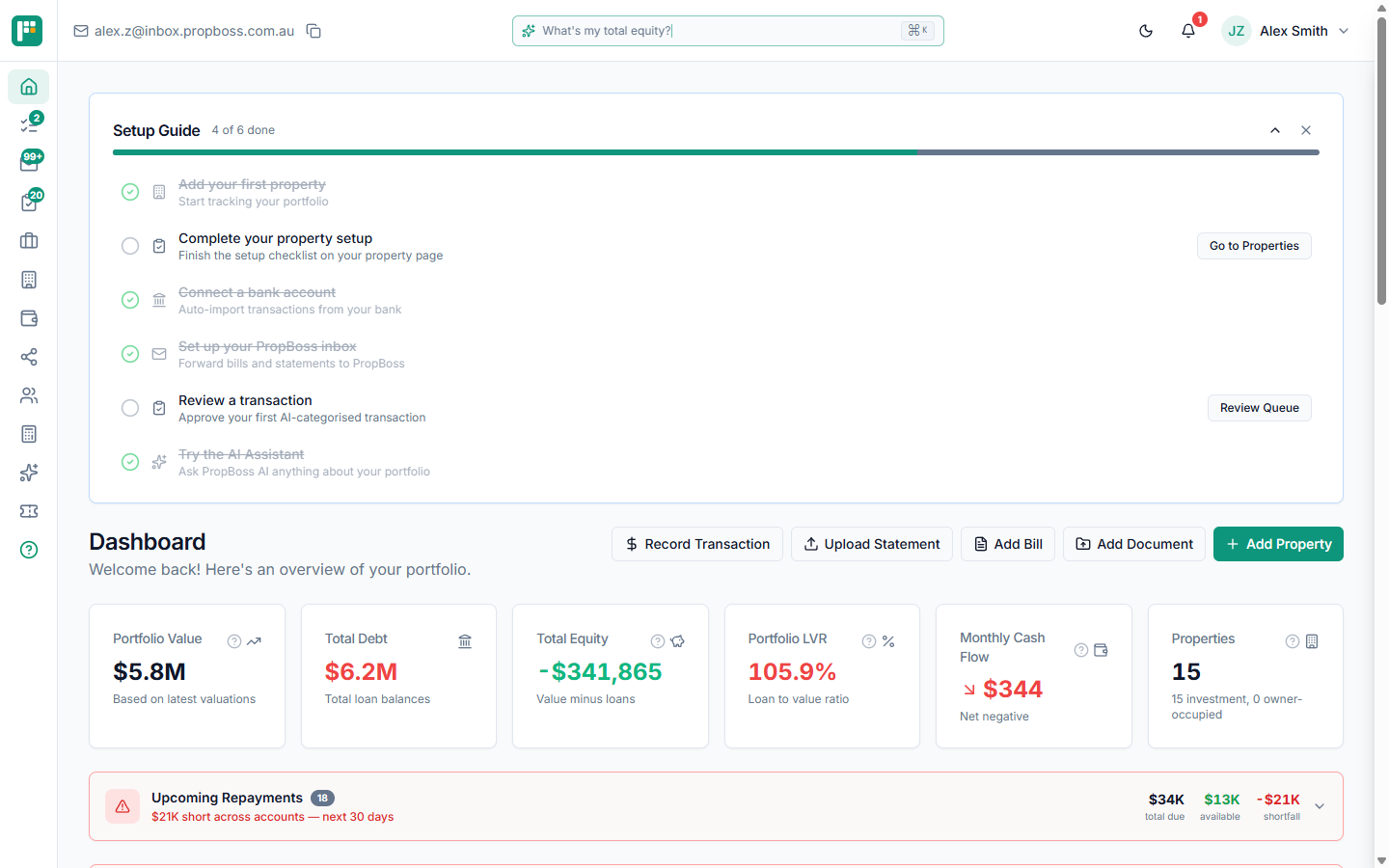
PropBoss is built for exactly this situation. Each property is tagged as PPOR or investment, the dashboard applies the right tax treatment automatically, and bank feeds keep the records clean for EOFY. When you model a sale, the system shows the CGT impact with and without principal place of residence status so you can see exactly what the exemption is worth in real dollars. For a practical next step, read our guide to buying an investment property in Australia.
 For a practical next step, read our guide to buying an investment property in Australia.
Practical Checklist Before Selling or Moving
Before you sell a principal place of residence or change how you use it, run through this short checklist. It covers the main conditions the ATO and revenue offices will assess: For a practical next step, read our guide to buying an investment property in Australia.
-
Confirm the years and dates you physically lived in the property For a practical next step, read our guide to buying an investment property in Australia.
-
Pull together utility bills, driver's licence records, and mail addressed to the property For a practical next step, read our guide to buying an investment property in Australia.
-
Check whether any period was rented or used for business purposes For a practical next step, read our guide to buying an investment property in Australia.
-
Review whether the 6-year absence rule applies to any former period For a practical next step, read our guide to buying an investment property in Australia.
-
If the total land exceeds two hectares or covers multiple lots, decide which area to nominate For a practical next step, read our guide to buying an investment property in Australia.
-
If there are trust or beneficiary arrangements, get a written legal summary For a practical next step, read our guide to buying an investment property in Australia.
-
Notify the relevant revenue office of any change in principal place of residence For a practical next step, read our guide to buying an investment property in Australia.
A solid paper trail is the difference between a quick assessment and a slow, expensive dispute with the ATO over which taxes apply. For a practical next step, read our guide to buying an investment property in Australia.
Frequently Asked Questions
What is PPOR in Australia?
PPOR means principal place of residence - the home you actually lived in as your main dwelling. It is the property the ATO treats as your main residence for capital gains tax purposes and the property exempt from state land taxes. For a practical next step, read our guide to buying an investment property in Australia.
How long do you need to live in a PPOR?
There is no fixed minimum period in the CGT rules. The ATO weighs several conditions including how long you occupied the property, your mailing address, electoral roll entry, and intention. State first home buyer concessions usually require a minimum of 6 or 12 months of occupancy to qualify. For a practical next step, read our guide to buying an investment property in Australia.
Can you have two PPORs?
Generally no. An individual - and a married or de facto couple together - can only nominate one principal place of residence at any given time. The main exception is the 6 months overlap when you are moving between homes. For a practical next step, read our guide to buying an investment property in Australia.
Is my PPOR exempt from capital gains tax?
If the dwelling has been your main residence for the entire ownership period and meets the eligibility conditions, yes - you pay no CGT when you sell. Partial exemption applies if the property was ever rented, used for business purposes, or was your principal place for only part of the time. For a practical next step, read our guide to buying an investment property in Australia.
Is my PPOR exempt from land tax?
Yes, in every Australian state and territory. The exemption is sometimes automatic and sometimes requires you to apply with the relevant revenue office and supply supporting documents. For a practical next step, read our guide to buying an investment property in Australia.
Can I rent out my PPOR without losing the exemption?
You can for up to 6 years under the absence rule, provided the property was genuinely your main residence before you moved out and you do not nominate a different principal place during that period. Any person considered to be in continuous residence elsewhere would break the rule. For a practical next step, read our guide to buying an investment property in Australia.
What happens to my PPOR exemption if I move overseas?
If you are a foreign resident for tax purposes on the day you sell, you generally lose access to the main residence exemption entirely - even for the years you lived in the property as an Australian resident. Life-event exceptions apply narrowly. For a practical next step, read our guide to buying an investment property in Australia.
Does a unit or flat qualify as a PPOR?
Yes. A unit, flat, townhouse, duplex or studio apartment all qualify if you lived in the place as your main home. The style of residential building does not change the outcome. For a practical next step, read our guide to buying an investment property in Australia.
Track Your PPOR Status with PropBoss
Getting your principal place of residence right is worth more than any other tax-planning decision most Australian property owners ever make. It is also the one most likely to fall through the cracks when you move between homes, convert a principal place into a rental, or add new residential investments to a portfolio. For a practical next step, read our guide to buying an investment property in Australia.
PropBoss tracks principal place of residence status, land tax eligibility, and CGT projections across your entire portfolio in one dashboard. Bank feeds keep the records clean, and every property is tagged with its current tax treatment so there is no guesswork at EOFY on which taxes you owe. Try PropBoss free and see how much your principal place of residence is actually worth. For a practical next step, read our guide to buying an investment property in Australia.
Track Your Real Portfolio with PropBoss
Stop guessing with calculators and spreadsheets. PropBoss automatically tracks your rental income, expenses, bank feeds, depreciation, and tax position across your entire portfolio.

Jonathan Zuvela
Founder, PropBoss
Jonathan is an Australian property investor and the founder of PropBoss - an AI-powered platform that helps investors automate their property admin, track rental income and expenses, and make data-driven investment decisions.
Related Articles
Cash Flow Record Keeping Checklist Australia 2026
A practical checklist for Australian property investors to keep cash flow records accurate across rent, loan interest, recurring costs, repairs, and portfolio review.
Read more
Rental Property Record Keeping Guide Australia 2026
A practical rental property record keeping guide for Australian property investors, covering rental income, loan interest, repairs, capital improvements, portfolio review, and tax-time evidence.
Read more
Property Investment Record Keeping Checklist Australia 2026
A practical checklist for Australian property investors to keep rental income, loan, expense, tax, and portfolio records organised before tax time.
Read more