
QLD Land Tax 2026: Thresholds, Rates & Exemptions for Investors
Queensland land tax catches more property investors every year as land values climb. This 2026 guide breaks down the current QLD land tax rates, thresholds, exemptions and the legal ways to reduce your bill — with worked examples for resident individuals, companies, trusts and absentee owners.
 Jonathan Zuvela
If your Queensland freehold land is worth $600,000 or more (or $350,000 for trusts and companies), you almost certainly need to pay queensland land tax — and the 30 June 2026 assessment date is when that bill locks in. It's an annual state tax on the unimproved value of your land holdings, with progressive rates that bump you into a higher bracket every extra $100,000.
South East Queensland values have lifted sharply since 2020, dragging more investors over the threshold for the first time. Many property owners only discover they need to pay tax when the land tax assessment notice from the Queensland Revenue Office (QRO) arrives months later. This 2026 guide covers current land tax rates, exemptions and how to manage your land tax obligations before EOFY.
What Is Land Tax in Queensland?
Land tax is an annual state tax imposed on the total taxable value of all freehold land owned in Queensland as of midnight on 30 June each year. The Queensland Revenue Office administers it for the queensland government — not the ATO. The queensland government uses these state revenues to fund health, education and transport. Unlike stamp duty, you pay land tax every year you hold investment land above the threshold. The tax rate applies to the unimproved value — the dirt itself — as set by the Valuer-General. The current land tax regime under the Land Tax Act 2010 has applied since the 1915 origins of state tax in Queensland.
What Counts as Freehold Land?
Freehold land is privately owned land where the owner holds the title outright. For land tax purposes, freehold land includes:
- Residential investment properties (the land component, not the building)
- Vacant land held for future development
- Commercial land, industrial freehold land and other commercial properties
- Land held by a trust or company in Queensland
- Holiday homes and second residences (unless an exemption applies)
Leasehold and most Crown land sit outside the freehold base. If you hold land in multiple Australian states, only your Queensland freehold land counts toward your assessment. Queensland's controversial 2022 proposal to aggregate interstate land holdings was scrapped that September after pushback from foreign owners, interstate investors and other state premiers.
Current Land Tax Rates in QLD (FY2025–26)
Your tax rate depends on the type of owner. The QRO uses three rate schedules: resident individuals, companies/trustees, and absentees.
Land Tax Rates for Resident Individuals
For Australian citizens, permanent visa holders and individuals who ordinarily reside in Australia, the threshold is $600,000 of total taxable value and the marginal tax rate starts at 1 cent in the dollar.
| Total Taxable Value | Land Tax Payable |
|---|---|
| $0 – $599,999 | $0 |
| $600,000 – $999,999 | $500 + 1.0¢/$1 over $600,000 |
| $1,000,000 – $2,999,999 | $4,500 + 1.65¢/$1 over $1,000,000 |
| $3,000,000 – $4,999,999 | $37,500 + 1.25¢/$1 over $3,000,000 |
| $5,000,000 – $9,999,999 | $62,500 + 1.75¢/$1 over $5,000,000 |
| $10,000,000+ | $150,000 + 2.25¢/$1 over $10,000,000 |
These current land tax rates apply for the 2025–26 assessment year. Source: Queensland Revenue Office.
Company Owner, Trustee & Absentee Rates
Where the owner is a company, trustee or absentee individual, the threshold drops to $350,000 and the marginal tax rate climbs faster. The land tax threshold for absentee owners includes a surcharge on top of the standard rates applicable to companies and trusts — originally 2% when introduced, now stepped up to 3% for foreign companies, foreign individuals and trustees on the value above $350,000.
| Total Taxable Value | Companies & Trustees | Absentee Individuals |
|---|---|---|
| $0 – $349,999 | $0 | $0 |
| $350,000 – $2,249,999 | $1,450 + 1.7¢ over $350,000 | $1,450 + 1.7¢ over $350,000 |
| $2,250,000 – $4,999,999 | $33,750 + 1.5¢ over $2,250,000 | $33,750 + 1.5¢ over $2,250,000 |
| $5,000,000 – $9,999,999 | $75,000 + 2.25¢ over $5,000,000 | $75,000 + 2.0¢ over $5,000,000 |
| $10,000,000+ | $187,500 + 2.75¢ over $10,000,000 | $175,000 + 2.5¢ over $10,000,000 |
A trustee of a special disability trust is assessed at the more generous individual rate scale.
How the Land Tax Threshold in Queensland Works
The land tax threshold is the value of your land below which no tax is owing:
- Resident individuals: $600,000 land tax threshold
- Companies, trustees, absentees: $350,000 land tax threshold
Land tax is only payable when the total unimproved value of land owned exceeds the applicable threshold as of midnight on 30 June each year. The threshold applies to your aggregated Queensland land holdings — every parcel of land owned in the state is added together to get your combined value. Three Brisbane investments at $250,000 land value each total $750,000 — above the resident threshold, so land tax applies. Land held jointly with a spouse is assessed on each owner's share, but the joint land is also assessed at the joint-owner level. Land held in different ownership structures — one new property in your name and another through a family trust — is assessed separately under each owner's threshold.
How Is Land Tax Calculated in QLD?
Calculating land tax in Queensland is a three-step process. Calculating land tax for a multi-property portfolio is the same in principle: aggregate, then apply the formula. Understanding it helps you predict your land tax liability before 30 June.
Step 1: Determine the Taxable Value
The Valuer-General publishes an annual statutory valuation for every parcel of freehold land in Queensland — generally a 3-year average value smoothed across recent valuation cycles to reduce shock from year-to-year movements. Check the value of your land on the Queensland Globe or your latest valuation notice.
Step 2: Add Up Your Total Taxable Value
Sum the value of every parcel you own at midnight 30 June to get your total taxable land value. This figure — your total land value across all Queensland holdings — determines your bracket. If your total taxable land exceeds the threshold for your owner type, land tax applies and the bill flows from there.
Step 3: Apply the Tax Rate
Find your bracket and apply the formula. Land tax rates in Queensland are progressive, meaning they increase as the total taxable value of land holdings rises, with different rates applicable to individuals, companies, and trusts. Tax applies on the portion above the threshold, plus the fixed dollar amount.
Worked example — Brisbane investor with multiple investment properties: - Annerley investment (land value): $480,000 - Logan investment (land value): $320,000 - Combined value: $800,000 → bracket $600K–$999,999 - Land tax payable: $500 + 1.0¢ × ($800,000 − $600,000) = $2,500/year
Worked example — Sunshine Coast property portfolio in a family trust: - Mooloolaba (land value): $720,000 - Caloundra townhouse (land value): $385,000 - Total land value: $1,105,000 → trust bracket $350K–$2.25M - Land tax payable: $1,450 + 1.7¢ × ($1,105,000 − $350,000) = $14,285/year
The same property portfolio held through a trust pays roughly 5.7× more than the same land owned by a resident individual below the individual threshold — proof that structure matters in Queensland.
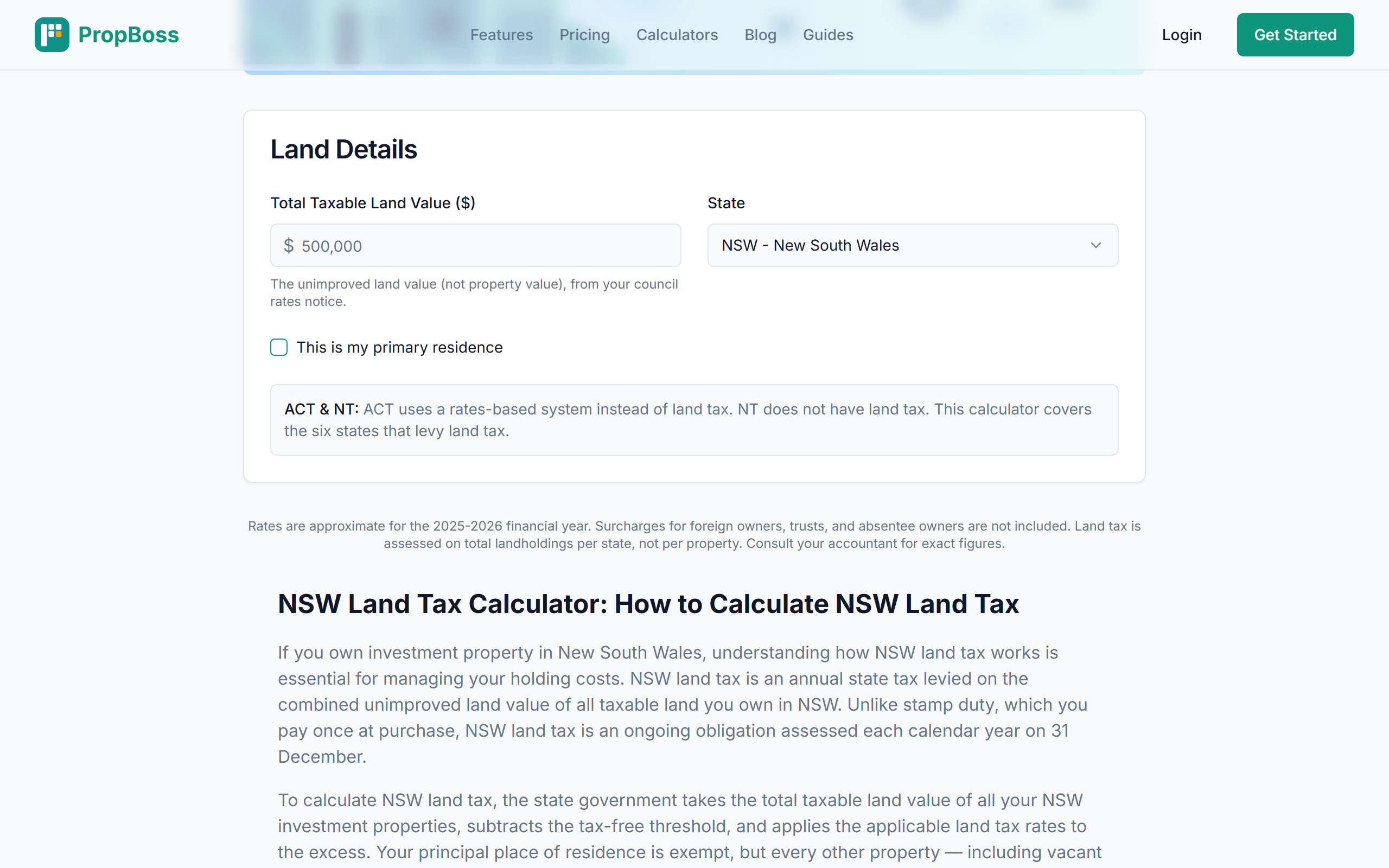
For a quick estimate, use the PropBoss land tax calculator — it covers every state and shows how a small change in land value can push you across a bracket.
Land Tax Exemptions: What Is Exempt from Land Tax?
Several categories of freehold land are generally exempt from land tax in Queensland, even when their value sits above the threshold. Where these exemptions apply, the QRO removes that parcel from your assessable holdings. The major land tax exemptions are listed below.
Home Exemption (Principal Place of Residence)
Your principal place of residence is fully exempt under the home exemption — meaning you do not pay land tax on the home where you live. The QRO usually applies it automatically when records show the land is your place of residence; you'll receive a notice confirming the effective date. If it isn't applied, lodge an application via QRO Online. The exemption is per-owner: if you and your spouse jointly own one place of residence, both can claim on their share — but you can only claim one place of residence at a time. If you are temporarily renting out your home while transitioning to a new property, you may still qualify for a transitional exemption from land tax.
Primary Production Land
Freehold land used for the business of primary production — farming, grazing, horticulture, aquaculture — can be exempt. The land must be genuinely used by a primary producer, not simply held for capital growth.
Build-to-Rent Concession
Eligible build-to-rent (BTR) developments receive a 50% reduction in the value used to calculate land tax, plus a full exemption from the foreign investor surcharge for up to 20 years.
Other Land Tax Exemptions
Certain land owned by charitable or non-profit organizations is exempt from land tax, including land used exclusively for charitable, religious, or educational purposes. Government-owned land and certain moveable dwelling parks are also generally exempt. Aged care facilities meeting the eligibility tests are likewise exempt — these aged care facilities cover residential aged care under the Commonwealth scheme. Where multiple exemptions apply, the QRO generally applies the most favourable one.
Who Needs to Pay Land Tax on Investment Properties?
Yes — investment properties are the most common reason QLD owners need to pay land tax. Because investment land cannot claim the home exemption, the full unimproved value counts toward your taxable value.
Common scenarios where investors need to pay land tax in queensland:
- One investment property under $600,000 land value: No land tax owing (resident individual).
- Two investment properties with combined land over $600,000: Tax applies on the portion above the threshold.
- Investment property held in a family trust: Tax applies from $350,000.
- Investment property owned by a foreign resident: $350,000 threshold plus 3% absentee surcharge.
- Vacant land held for future development: The assessment includes vacant land — and since QRO includes vacant land in the same way as built investment land, this catches developers off-guard.
Investors who hold multiple properties through one structure can quickly find their total value pushing into brackets where the marginal rate climbs to 1.65¢, 1.75¢ or even 2.75¢ in the dollar. Owning multiple properties under different entities can sometimes help — but always check the value of your land position carefully across each entity first.
When Do You Pay Land Tax in QLD?
Three dates matter:
- Liability date — midnight 30 June. Whoever owns the land then is liable for the full year. Buying on 1 July avoids that year's bill (subject to contract apportionment); buying on 29 June makes you liable.
- Land tax assessment notice issued — October to April of the following financial year. Payment of the land tax bill is due 90 days after the date on the land tax assessment notice, or in three approved instalments. Failure to pay can prompt legal action by the QRO.
- Sale of property — land tax clearance certificate. Conveyancing usually requires a land tax clearance certificate from the QRO so the buyer knows whether unpaid tax sits as a charge against the title. The land tax clearance certificate is essential at settlement.
How to Avoid or Reduce Queensland Land Tax (Legally)
There are no shortcuts that erase land tax. The legitimate strategies all involve ownership structure, timing and exemptions. The QRO pursues schemes designed solely to avoid land tax, so any approach must have genuine commercial or personal purpose. Always seek legal advice or professional advice before restructuring.
Stay Under the Threshold
The simplest way to avoid land tax in Queensland is to keep aggregate land below the threshold for your owner type — under $600,000 for a resident individual.
Claim Every Exemption
If you live in one of your properties, ensure the home exemption is applied. If part of your land is used for primary production, lodge that exemption. Unclaimed land tax exemptions cost investors thousands every year.
Consider Joint or Spousal Ownership
Holding land jointly 50/50 with a spouse can sometimes keep both individuals under the $600,000 threshold — but joint land is also assessed at the joint level. Speak to a Queensland property tax adviser before relying on this.
Be Cautious With Trusts
A discretionary or unit trust is useful for asset protection, but it triggers the lower $350,000 trust threshold. A $700,000 property held through a trust generates more tax than holding it personally. Get legal and financial advice before restructuring an existing portfolio.
Model Scenarios Before You Buy
Modelling how the next purchase pushes your aggregate value into the next bracket — before you sign the contract — is the cheapest planning you can do.
Is Queensland Land Tax Tax-Deductible?
Yes — when paid on income-producing investment properties, queensland land tax is a fully deductible rental expense in the year you pay tax. The ATO confirms this in its residential rental properties guide: land tax sits alongside council rates and landlord insurance as immediately deductible.
A few rules:
- The deduction is claimed in the year tax is paid, not assessed.
- Tax on your principal place of residence is not deductible (no rental income).
- Tax on vacant land held for future investment is generally only deductible once income-producing, due to the 2019 vacant land deduction rules.
- Apportion if the property was rented for only part of the year.
Frequently Asked Questions on Land Tax in Queensland
Does QLD have land tax?
Yes. Queensland has had land tax since 1915. The QRO administers it and assesses each year at midnight on 30 June.
How much is land tax in QLD?
Resident individuals pay nothing below $600,000, then $500 + 1¢ for each $1 above. Trusts and companies start paying from $350,000 with a higher base rate.
How is land tax calculated in QLD?
The QRO sums the unimproved value of every parcel you own at midnight 30 June, applies the rate schedule for your owner type, then issues an assessment notice with the total value owing.
What is the land tax threshold in QLD?
$600,000 of total taxable value for resident individuals; $350,000 for companies, trustees and absentees.
Do you pay land tax on your own home in QLD?
No — your principal place of residence is exempt. Provided you genuinely live there as your main place of residence, no tax applies.
Do you pay land tax on units in QLD?
Yes. A unit or apartment held as an investment is treated the same as any other freehold land — your strata land share counts toward your taxable value.
When did land tax start in QLD?
1915 — making it one of the oldest continuously levied state taxes in Australia.
What is the difference between SRO and QRO land tax?
"SRO" usually refers to the State Revenue Office of Victoria. In Queensland, the equivalent is the Queensland Revenue Office. The OSR (Office of State Revenue) was the QRO's earlier name.
Track Your Land Tax Liability with PropBoss
Land tax is a recurring, growing cost of investment property ownership in Queensland. The only way to plan around it is to know your numbers before 30 June each year.
PropBoss tracks the unimproved value of every property in your portfolio, rolls those up to your total value owing, and shows exactly which bracket you sit in. The platform supports property owners managing one investment up to large multi-state portfolios. When the QRO assessment notice lands, it's already in your year-to-date deductions and cash flow forecast.
- Estimate your bill with the PropBoss land tax calculator — every state, every owner type.
- Get started free — track land tax, depreciation and CGT in one place.
- See our Australia-wide land tax guide for NSW, VIC, WA and SA equivalents; the capital gains tax calculator shows how this flows into your sale.
Written by Jonathan Zuvela, Founder of PropBoss. Last updated: April 2026. General information only — confirm current rates with the Queensland Revenue Office or your registered tax agent. Sources: QRO calculations, QRO exemptions, ATO rental properties.
Track Your Real Portfolio with PropBoss
Stop guessing with calculators and spreadsheets. PropBoss automatically tracks your rental income, expenses, bank feeds, depreciation, and tax position across your entire portfolio.

Jonathan Zuvela
Founder, PropBoss
Jonathan is an Australian property investor and the founder of PropBoss - an AI-powered platform that helps investors automate their property admin, track rental income and expenses, and make data-driven investment decisions.
Related Articles
Cash Flow Record Keeping Checklist Australia 2026
A practical checklist for Australian property investors to keep cash flow records accurate across rent, loan interest, recurring costs, repairs, and portfolio review.
Read more
Rental Property Record Keeping Guide Australia 2026
A practical rental property record keeping guide for Australian property investors, covering rental income, loan interest, repairs, capital improvements, portfolio review, and tax-time evidence.
Read more
Property Investment Record Keeping Checklist Australia 2026
A practical checklist for Australian property investors to keep rental income, loan, expense, tax, and portfolio records organised before tax time.
Read more