
Positively Geared Property: Find Cash Flow Positive Investments (2026)
A complete guide to positively geared property in Australia -- what positive gearing means, how to calculate cash flow, real examples with numbers, and strategies for finding cash flow positive investment properties in 2026.
 Jonathan Zuvela
Positively Geared Property: How to Find Cash Flow Positive Investments in 2026
A positively geared property is an investment property that earns more in rental income than it costs to hold. After the loan, rates, insurance, management fees, and maintenance are paid, money is still left over. For property investors chasing financial freedom, positive gearing is attractive because the asset helps fund the portfolio instead of leaning on your salary.
For years, many Australian property investors have accepted negative gearing because of the potential tax benefits. But a loss-making property still needs cash from somewhere. Positive cash flow property investing asks a different question: can the rent cover loan repayments, management costs, insurance, and routine expenses without a monthly top-up?
This guide covers how positive gearing works, how to calculate whether a property is positively geared, and where investors are still finding cash flow positive properties in 2026.
What Is a Positively Geared Property?
A positively geared property generates more rental income than it costs to own. If weekly rent is higher than loan repayments, management fees, insurance, council rates, body corporate fees, vacancy allowance, and maintenance, the property is positively geared.
In plain English, positive gearing means the investment property creates net income. That positive cash flow can sit in an offset account, pay down debt, fund repairs, or help with the next deposit. It puts cash flow first instead of relying only on future capital gain.
Here is the basic positive gearing formula:
Rental Income - Total Expenses = Cash Flow
- If the result is positive -> the property is positively geared
- If the result is negative -> the property is negatively geared
The practical difference is simple. A positive geared property does not ask you to fund a monthly shortfall. The positive cash flow property pays its own way and leaves additional income on top.
Positive Gearing vs Negative Gearing: Which Investment Strategy Wins?
The positive gearing vs negative gearing debate has been around for decades, and both strategies can work. They just solve different problems. (For a deep comparison, see our guide: Negative Gearing vs Positive Gearing: Which Strategy Wins in 2026?)
How Negative Gearing Works
With a loss-making investment property, total expenses exceed rental income. The loss can reduce taxable income, so you may pay less income tax. Many property investors accept that negative cash flow because they expect long-term capital growth to do the heavy lifting.
The trade-off is cash pressure. You need job or business income to cover the monthly shortfall, which can widen if interest rates rise or rent falls. Positive gearing reduces that pressure and can improve borrowing capacity.
How a Positive Cash Flow Property Works
With a positive cash flow property, the rental income covers the bills and leaves a surplus. The compromise is that this type of positive geared property is often in a regional or lower-priced market, so capital growth may differ from an inner-city growth asset.
| Factor | Positive Gearing | Negative Gearing |
|---|---|---|
| Cash flow | Positive cash flow each month | Shortfall you must cover |
| Tax impact | Increases taxable income | Reduces taxable income |
| Capital growth | Often lower (regional) | Often higher (metro) |
| Risk profile | Lower -- self-funding | Higher -- salary-dependent |
| Borrowing capacity | Improves serviceability | Reduces serviceability |
For property investors building a larger property portfolio, a mix can make sense: positive geared property for cash flow, and selected growth assets for equity. The income from one positive cash flow property can help fund another property's holding costs. Speak with a financial advisor or financial planner before committing.
How to Calculate If a Property Is Positively Geared
You cannot tell whether an investment property is positively geared from rent and purchase price alone. You need a full cash flow calculation, including costs that are easy to miss. Here is a worked example using 2026 assumptions.
Worked Example: $480,000 Property in Townsville
Purchase price: $480,000 Loan amount: $384,000 (80% LVR) Interest rate: 6.29% (interest only) Weekly rent: $520
Annual Income
| Source | Amount |
|---|---|
| Rental income (52 weeks x $520) | $27,040 |
| Total income | $27,040 |
Annual Expenses
| Expense | Amount |
|---|---|
| Mortgage repayments (interest only) | $24,154 |
| Property management fees (7.7% + GST) | $2,290 |
| Council rates | $2,400 |
| Insurance (building + landlord) | $1,800 |
| Land tax (QLD threshold) | $0 |
| Maintenance costs (allowance) | $1,200 |
| Water rates | $800 |
| Total expenses | $32,644 |
Cash Flow Result
$27,040 - $32,644 = -$5,604 per year (negative cash flow)
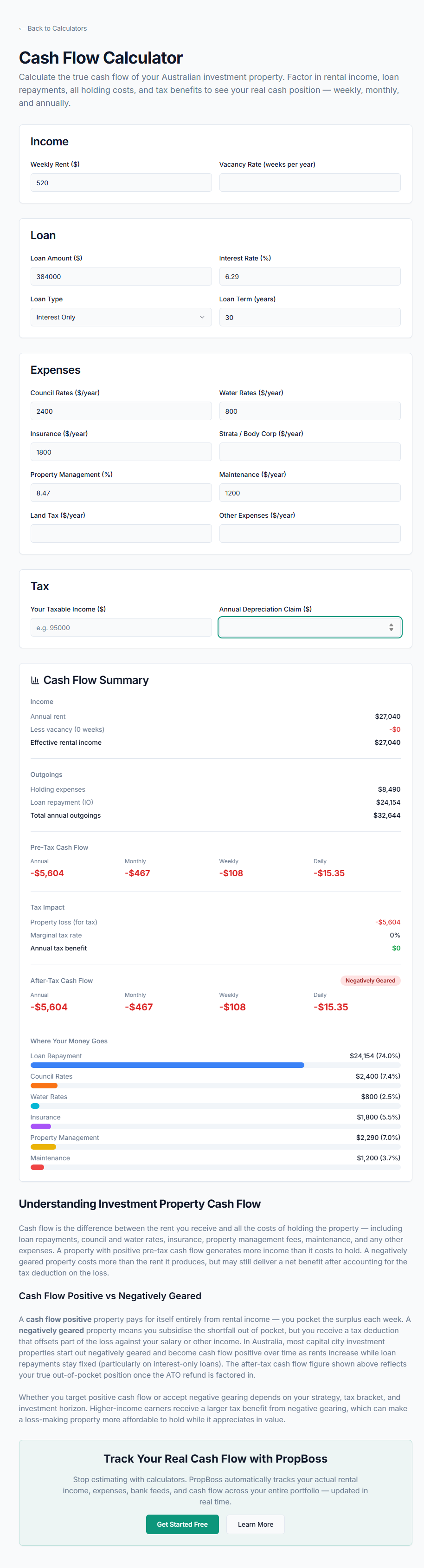
At 80% LVR, total expenses exceed rental income. The investment property exceeds its income threshold and is not yet positively geared. If positive gearing is the goal, the numbers need adjusting.
Making a Property Positively Geared
If the same investor puts down 40% instead of 20%:
- Loan amount: $288,000
- Loan interest: $18,115 per year
- Total expenses: $26,605
- Cash flow: $27,040 - $26,605 = +$435 per year
The same property changes once the debt is lower. Positive gearing becomes achievable because loan interest drops. Another path is higher rent: if the rental yield improves to $560 per week at the original 80% LVR, the positive cashflow moves closer to breakeven or better.
Use the PropBoss Cash Flow Calculator to test this properly. Add the purchase price, rental income, interest rates, and expenses, then check whether the result is cash flow positive or negative before you make an offer.
Common Property Investment Strategies for Positive Cash Flow
Finding a cash flow positive property in 2026 is still possible, but it takes deliberate filtering. These are the approaches Australian property investors tend to use.
Target High Rental Yield Suburbs
The fastest path to positive cash flow is buying where rental yield is high relative to the purchase price. In 2026, several regional markets consistently deliver gross yields above 6%:
- Townsville, QLD -- median house $420K, gross yield 5.8-6.5%
- Rockhampton, QLD -- median house $340K, gross yield 6.2-7.1%
- Mount Isa, QLD -- median house $280K, gross yield 7.5-9.0%
- Geraldton, WA -- median house $320K, gross yield 6.0-7.0%
- Kalgoorlie, WA -- median house $310K, gross yield 7.0-8.5%
- Burnie, TAS -- median house $360K, gross yield 5.5-6.2%
These are markets where investors still find positive gearing opportunities. The numbers work because the entry price is lower relative to rent. Strong rental demand and affordable prices do most of the work.
Vacancy matters as much as headline yield. A low vacancy rate, ideally under 2%, points to stronger tenant demand and less downtime. Four empty weeks can wipe out the surplus on a positively geared property.
Reduce Your Holding Costs
If you already own an investment property that is close to cash flow positive, reducing expenses can tip the balance:
- Refinance to lower loan interest -- even 0.3% lower on a $400K loan saves $1,200 per year
- Switch to interest only loan repayments -- reduces your outgoings in the short term
- Shop management fees -- rates range from 5.5% to 8.8% depending on the property manager
- Claim all tax deductible expenses -- depreciation, travel, and repair costs reduce your net cash outflow. Non cash tax deductions like depreciation are especially valuable for positive gearing
- Use an offset account -- parking surplus cash in an offset account linked to your investment loan reduces the loan interest you pay, improving your tax position
Positive Real Estate Through Value-Add Renovations
A value-add renovation can turn a marginal property into a positive cash flow property. Adding a bedroom, second bathroom, or compliant granny flat may lift rental income without a matching increase in entry cost. A $30,000 renovation that lifts weekly rent by $80 pays for itself in under eight years, then the positive geared property keeps producing better positive cashflow.
Avoid Common Positive Gearing Traps
The common traps are practical: using advertised rents instead of achieved rents, chasing a huge yield without considering capital gain potential, or forgetting strata, insurance excesses, and vacancy allowances. That is how a positive cash flow property on paper becomes loss-making in practice.
Tax Implications of a Positively Geared Property
Positive gearing affects tax straight away. Unlike a loss-making rental property, where the loss can reduce your income tax, a positively geared investment property adds net rental profit to taxable income.
How Positive Gearing Affects Your Tax
The net profit from a cash flow positive property is added to salary, business income, dividends, and other income, then taxed at your marginal rate. If your positively geared property generates $5,000 in positive gearing profit and your marginal tax rate is 37%, the extra tax bill is about $1,850 before Medicare levy.
This is where tax benefits like depreciation become useful. A depreciation schedule, one of the most valuable non cash tax deductions, can produce $5,000-$15,000 in deductible claims per year for some newer properties, reducing income tax on positive gearing income.
Key Tax Deductible Expenses for Positive Cash Flow Property
Even though you are earning positive cash flow, you can still claim substantial tax deductible expenses:
- Loan interest (the interest component of your loan repayments)
- Property management fees
- Insurance premiums
- Council rates and water rates
- Repairs and maintenance costs
- Depreciation (Division 40 plant and equipment + Division 43 capital works)
- Travel costs for property inspections (if interstate)
These deductions reduce taxable rental profit and improve your tax position. For a positive cash flow property, every legitimate deduction matters because it increases net income after tax.
The ATO requires investors to declare rental income and claim only legitimate deductions. PropBoss tracks cash flow across the portfolio and categorises transactions against ATO-compliant categories.
Capital Growth vs Positive Cash Flow: Balancing Your Property Investing Strategy
Many property investors treat positively geared property and capital growth as opposites. They are not always mutually exclusive, but finding both in one deal is harder.
The classic approach is a balanced property portfolio:
- Positive cash flow property holdings in regional areas that generate net income to cover holding costs
- Capital growth properties in metro areas that build equity over time but require negative cash flow support
The primary goal of real estate investing with positive gearing is surplus cash flow. Loss-making properties usually rely more on long-term capital gain. In a balanced portfolio, positive cash flow from your positive geared property holdings can fund shortfalls on growth plays. Over time, as rents rise, some loss-making properties may become positively geared, a shift often called "organic positive gearing."
The additional income generated from a positively geared property can be used to pay down debt faster, cover living expenses, or be reinvested into more than one property to accelerate portfolio growth.
Investors nearing retirement may particularly prefer positive cash flow property for consistent income rather than speculative capital gain. When you no longer have employment income to cover shortfalls, positive gearing income from investment properties becomes essential.
For investors targeting financial freedom, the goal is a portfolio where combined positive gearing income exceeds living expenses. That is when rental income can start replacing salary. A financial advisor can map that path against your financial situation.
Purchase Price and Its Impact on Cash Flow
The purchase price is the single biggest lever in determining whether a property is positively geared. A lower purchase price relative to rental income means a higher yield -- and a better chance of achieving positive cash flow.
Consider two identical properties generating $500 per week in rental income:
- Property A (entry price $600K): Gross yield 4.3% -> almost certainly negative cash flow
- Property B (entry price $380K): Gross yield 6.8% -> strong positive gearing potential
That is why positive cash flow property is usually easier to find in lower-priced regional markets than in Sydney or Melbourne. In many capital-city suburbs, the property market has compressed yields to 3-4%, making positive gearing difficult without a large deposit.
Property Market Trends for Cash Flow Positive Investing in 2026
The 2026 property market is giving cash-flow-focused investors more openings. If interest rates ease, holding costs improve for investment property owners. Regional migration and flexible work are also supporting rental income in overlooked markets.
Property investors watching the cash flow real estate space should monitor:
- RBA rate decisions -- each 0.25% cut improves cash flow by approximately $1,000 per year on a $400K loan
- Rental vacancy rates -- tighter markets = higher rents = better positive cash flow
- Regional infrastructure spending -- new hospitals, universities, and transport links drive rental demand
Why Positive Gearing Is Gaining Popularity Among Property Investors
The renewed interest in positive gearing is a risk conversation. After higher interest rates, investors have seen how quickly a loss-making property can hurt cash flow. A property that costs $200 per week to hold can become a $350 per week drain after a 2% rate move.
Positive gearing gives you a buffer. If a positive geared property generates positive cash flow, a rate rise eats into the surplus before creating a new out-of-pocket bill. That resilience is why positive gearing has become a more popular investment strategy.
The best positive gearing opportunities combine affordable entry prices with strong rental demand. Regional centres with mining, healthcare, education, or government employment often deliver higher yields and steadier positive cash flow returns.
Frequently Asked Questions
What Is a Positively Geared Investment Property?
A positively geared investment property is one where total rental income exceeds holding costs, including loan repayments, management fees, insurance, rates, vacancy, and maintenance. The positive cash flow property generates net income, or positive cashflow, for the investor.
How Do You Make a Property Positively Geared?
You can make or find positively geared property by lifting rental income, reducing expenses, or lowering debt. Renovations, extra rooms, furnishing, refinancing, lower management fees, and a larger deposit can all help.
Where Can I Find Positively Geared Property for Sale in Australia?
Positive cash flow property is commonly found in regional Queensland, including Townsville, Rockhampton, and Mount Isa; regional Western Australia, including Geraldton and Kalgoorlie; and parts of Tasmania. Look for gross yields above 6%, then verify the positive gearing calculation with real expenses.
Is a Positive Geared Property Better Than a Negatively Geared One?
Neither strategy is automatically better. Positive gearing provides additional income and reduces cash-flow risk. Negative gearing can provide tax benefits and often targets higher capital gain. Many experienced property investors use both across a property portfolio.
Is There a Tool That Calculates Cash Flow Automatically?
PropBoss tracks cash flow across investment properties with automated bank feeds, depreciation schedules, and ATO-compliant reporting. The Cash Flow Calculator handles income, expenses, loan repayments, management fees, and tax savings, so you can see whether each property is a positive cash flow property or a loss-making one. Start your free trial ->
Achieve Financial Freedom with Cash Flow Positive Property Investing
Stop guessing whether your investment property is positively geared. PropBoss tracks rental income, loan repayments, management fees, and ongoing expenses automatically, showing the positive gearing position of every property in your portfolio.
For a broader portfolio forecast, read our cash flow real estate forecast. Try the Cash Flow Calculator -> | Start free -- $1/property/month after trial ->
For a full cost breakdown, see our investment property costs.
Track Your Real Portfolio with PropBoss
Stop guessing with calculators and spreadsheets. PropBoss automatically tracks your rental income, expenses, bank feeds, depreciation, and tax position across your entire portfolio.

Jonathan Zuvela
Founder, PropBoss
Jonathan is an Australian property investor and the founder of PropBoss - an AI-powered platform that helps investors automate their property admin, track rental income and expenses, and make data-driven investment decisions.
Related Articles
Cash Flow Real Estate: Forecast Property Returns in 2026
Learn how cash flow real estate works in Australia, with formulas, examples, due diligence checks and forecasting tools for investors.
Read more
Cash Flow Record Keeping Checklist Australia 2026
A practical checklist for Australian property investors to keep cash flow records accurate across rent, loan interest, recurring costs, repairs, and portfolio review.
Read more
Rental Property Record Keeping Guide Australia 2026
A practical rental property record keeping guide for Australian property investors, covering rental income, loan interest, repairs, capital improvements, portfolio review, and tax-time evidence.
Read more