
Capital Gains Tax on Rental Property: Australian Guide (2026)
Capital gains tax on rental property is one of the biggest costs Australian investors face when selling. This guide explains how CGT works on investment property, how to calculate your cost base and capital proceeds, the 50% CGT discount, capital losses, and proven strategies to reduce the capital gains tax you pay.
 Jonathan Zuvela
When you sell a rental property in Australia, you pay capital gains tax (CGT) on the profit -- the difference between your capital proceeds and what it cost you. The capital gain is added to your assessable income for the financial year, so you pay tax at your marginal tax rate.
For owners in the highest bracket (45%), a $200,000 gain can mean a $90,000 bill -- or $45,000 with the 50% CGT discount.
Getting the numbers right matters. This guide explains how rental property CGT rules work, with worked examples and current rates.
How Capital Gains Tax CGT Applies to Rental Property
Capital gains tax is not a separate tax -- it is part of your income tax (plus the 2% Medicare levy).
When you sell an investment property for more than it cost, the gain becomes part of your assessable income for that financial year. Someone earning $120,000 who realises a $60,000 gain could push into the $180,001+ bracket.
When Does a CGT Event Occur?
The Australian Taxation Office (ATO) requires you to report all gains and losses on your tax return. For rental property, a CGT event happens at the point of contract exchange -- not settlement.
For tax purposes, it is your tax obligations in the income year the contract is signed that determine when you pay CGT.
The basic formula:
Capital gain = Capital proceeds ? Cost base
If the sale price exceeds your cost base, you have a taxable capital gain. If the total costs are higher, you have a capital loss you can carry forward.
What Counts Toward Your Cost Base and Capital Proceeds
Your allowable base is more than just the purchase price. The ATO recognises five elements that make up your total acquisition and holding costs.
The Five Cost Base Elements
- Purchase price -- the original acquisition amount
- Incidental costs of acquisition -- stamp duty, legal fees, conveyancing, building inspections, and loan establishment fees
- Non-deductible ownership costs -- expenses you could not claim as a tax deduction during the holding period
- Capital improvements -- renovations, extensions, and structural additions (not repairs or maintenance costs)
- Incidental costs of disposal -- agent commissions, legal fees for the sale, and marketing
The higher these total costs, the lower your capital gain. Investors who track expenses carefully reduce their capital gains by thousands.
Keep receipts for every expense -- renovation invoices, solicitor bills, and inspection reports. For tax purposes, the ATO can ask for evidence going back the entire ownership period.
Your capital proceeds are everything you receive from the sale -- typically the selling price plus any additional amounts the buyer pays outside the contract.
The 50% CGT Discount for Capital Gains
If you hold your rental property for more than 12 months before selling, you qualify for the 50% discount on your capital gains. This halves the taxable portion, which can dramatically reduce the tax payable on your investment property.
How the CGT Discount Is Calculated
- Calculate your capital gain (sale price minus allowable base)
- Subtract any capital losses from current or prior years
- Apply the 50% discount to the remaining capital gain
- Add the discounted amount to your other earnings
- Pay tax at your marginal income tax rate
The 12 months runs from contract date of purchase to contract date of sale. Miss it by a day and you lose the discount entirely.
Who Cannot Claim the CGT Discount?
The discount is not available to companies. Trusts and self managed super fund entities have different rates.
Foreign residents who acquired Australian property after 8 May 2012 cannot claim any discount on their capital gains.
Pre-September 1999: Indexation vs Discount Method
If you purchased your rental property before 21 September 1999, you can choose between the 50% discount method or the indexation method (which adjusts your cost base for inflation using CPI). The indexation method freezes at the September 1999 quarter CPI.
For properties held since the 1990s with modest capital gains, indexation sometimes produces a better result than the 50% discount.
Worked Example: Capital Gains Tax on a Rental Property
Sarah bought an investment property in Brisbane in July 2020 for $520,000. She sells the rental property in April 2026 for $710,000.
Calculating Sarah's Net Capital Gain
| Item | Amount |
|---|---|
| Capital proceeds (sale price) | $710,000 |
| Cost base | |
| Purchase price | $520,000 |
| Stamp duty (QLD) | $17,350 |
| Legal fees (purchase + sale) | $3,300 |
| Building inspection | $500 |
| Kitchen renovation (2022) | $28,000 |
| Agent commission | $17,750 |
| Total cost base | $586,900 |
| Capital gain | $123,100 |
| Less: 50% discount (held >12 months) | ?$61,550 |
| Taxable capital gain | $61,550 |
How Much Tax Does Sarah Pay?
Sarah's other income is $95,000. Adding the $61,550 gain pushes her total to $156,550. At the 2025-26 Stage 3 tax rates (16% up to $45K, 30% to $135K, 37% to $190K), the capital gains tax on the rental property sale is approximately $19,974.
Without the discount, the tax on the full $123,100 would have been roughly $39,948 -- the discount saved nearly $20,000.
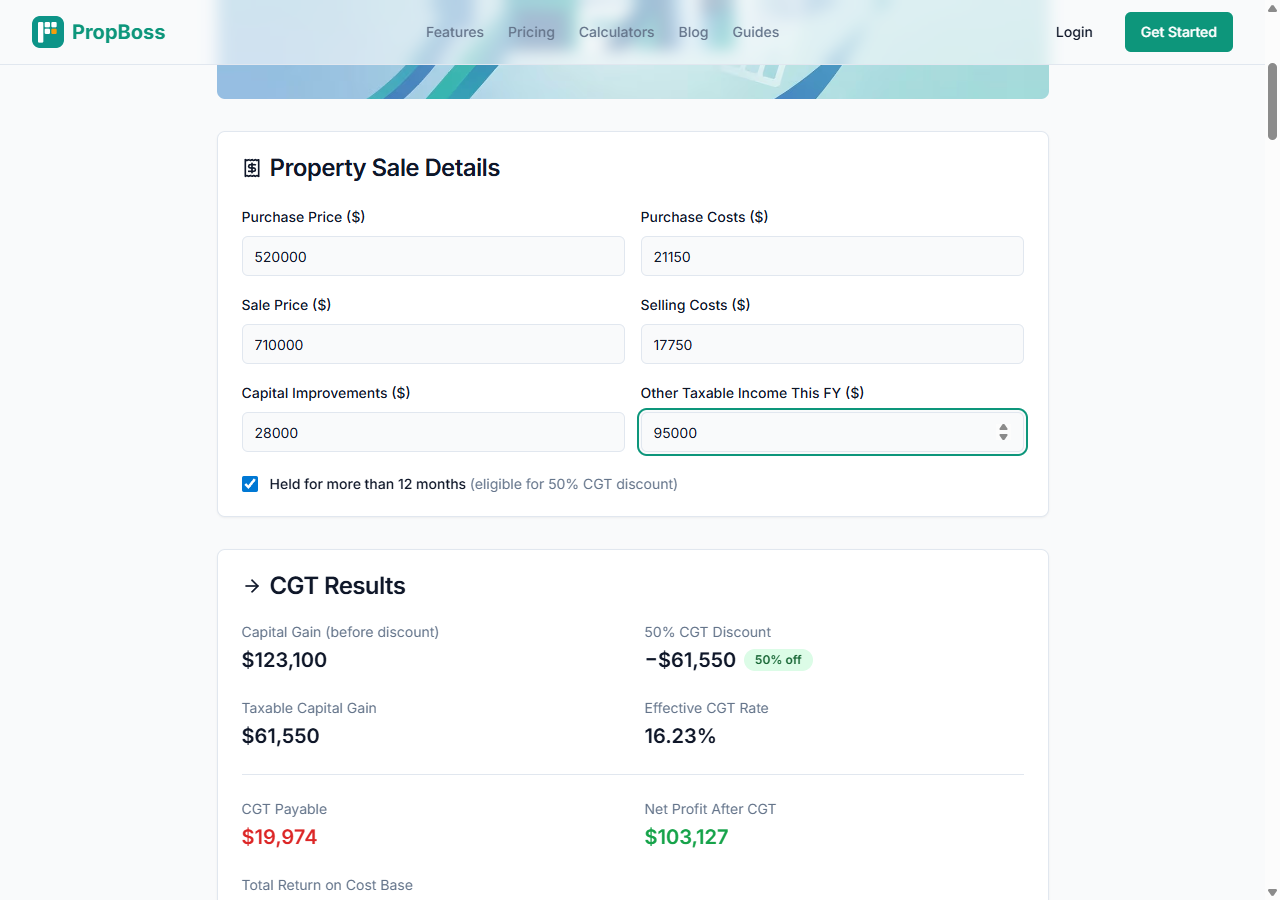
Use our capital gains tax calculator to estimate your own CGT liability with your specific numbers.
How Capital Losses Offset Your Capital Gains
A capital loss occurs when you sell a property for less than what it cost you. While nobody wants to sell at a loss, capital losses provide a valuable offset: they reduce your capital gains from other assets dollar-for-dollar.
Rules for Carrying Forward Capital Losses
- Apply losses before the 50% discount
- Unused losses carry forward indefinitely -- no expiry
- Capital losses cannot offset regular income (salary, rental income) -- only other capital gains
- A net capital loss in one financial year rolls forward automatically
How to Avoid Capital Gains Tax on Rental Property
There is no way to completely avoid capital gains tax on a dedicated rental property -- but there are legal strategies to reduce your CGT liability substantially.
The Main Residence Exemption and the 6-Year Rule
If the property was your home before becoming a rental, you may qualify for a full or partial main residence exemption.
The capital gains tax 6-year rule allows you to treat your former home as your principal residence for up to six years after moving out, even if it is rented out as an investment property. To qualify, the property must have been your home before you left, and you cannot nominate another property as your main residence during that time.
Hold for More Than 12 Months
While you cannot avoid CGT entirely on an investment property, this is the simplest strategy to halve it: hold for at least 12 months to qualify for the 50% discount, cutting the taxable capital gain in half.
Maximise Your Deductible Costs
Every legitimate expense reduces your capital gains. Items investors commonly miss in their property investment records:
- Stamp duty paid at purchase
- Legal fees for both purchase and sale
- Loan establishment fees (not interest)
- Capital improvements (renovations, not repairs)
Offset Capital Gains with Capital Losses
Sell underperforming assets in the same financial year to create capital losses that offset your capital gains from the rental property sale.
PropBoss handles this automatically -- the portfolio dashboard records each expense, capital improvement, and depreciation deduction before you sell.
Capital Gains Tax Rules for Foreign Residents
Foreign residents face stricter capital gains tax rules on Australian rental property. Since 8 May 2012, foreign residents cannot claim the 50% discount on Australian property capital gains.
Foreign Resident CGT Withholding
Buyers must withhold 12.5% of the purchase price at settlement for foreign-resident sales with a market value of $750,000 or more.
If you are a foreign resident, get tax advice before listing. CGT payable without the discount can be significantly higher.
Reporting Capital Gains on Your Tax Return
You must report all capital gains and capital losses in your tax return -- even if you have a net capital loss.
The ATO requires you to complete the CGT schedule, which captures asset details, dates, cost base, any losses applied, and the net gain after any discount.
Your accountant includes this in your annual return. Keep records for at least five years after the sale.
FAQs About Capital Gains Tax on Rental Property
How Is Capital Gains Tax Calculated on a Rental Property?
Subtract your cost base from the sale price to find your capital gain. If you held the property for more than 12 months, apply the 50% discount. The discounted capital gain is added to your taxable income and taxed at your marginal income tax rate.
Can You Avoid Capital Gains Tax on a Rental Property Entirely?
You cannot avoid capital gains tax on a property that has always been a rental. However, if it was your home first, the main residence exemption or the six year absence rule may eliminate your CGT liability entirely.
For a dedicated investment property, you can only reduce -- not eliminate -- the capital gains you owe.
Is There a Tool That Automates CGT Tracking for Rental Property?
PropBoss tracks your cost base, capital improvements, and unrealised gains with automated bank feeds and ATO-compliant reporting.
Start your free trial to see your portfolio's CGT exposure.
Run your numbers before listing.
Stop guessing what you'll owe the ATO. Use our capital gains tax calculator for a quick estimate, or sign up to PropBoss to track your position year-round. Plans start from $1/property/month.
For a deeper look, see our capital gains tax on inherited property.
Track Your Real Portfolio with PropBoss
Stop guessing with calculators and spreadsheets. PropBoss automatically tracks your rental income, expenses, bank feeds, depreciation, and tax position across your entire portfolio.

Jonathan Zuvela
Founder, PropBoss
Jonathan is an Australian property investor and the founder of PropBoss - an AI-powered platform that helps investors automate their property admin, track rental income and expenses, and make data-driven investment decisions.
Related Articles
Cash Flow Record Keeping Checklist Australia 2026
A practical checklist for Australian property investors to keep cash flow records accurate across rent, loan interest, recurring costs, repairs, and portfolio review.
Read more
Rental Property Record Keeping Guide Australia 2026
A practical rental property record keeping guide for Australian property investors, covering rental income, loan interest, repairs, capital improvements, portfolio review, and tax-time evidence.
Read more
Property Investment Record Keeping Checklist Australia 2026
A practical checklist for Australian property investors to keep rental income, loan, expense, tax, and portfolio records organised before tax time.
Read more