
Rental Property Management Explained
A practical rental management guide for Australian investors using state notice rules, fee checks, and live calculator examples.

Last updated: April 2026 | Financial year 2025-26
Rental property management is the day-to-day system that keeps an investment property performing: setting rent, choosing tenants, issuing the right lease agreement, handling repairs, tracking the bond, following state rules, and protecting cash flow when things go wrong. It sits at the point where compliance, tenant experience, and portfolio returns all meet.
For Australian investors in 2026, rental management matters more than ever. Vacancy is still tight in many markets, but regulators and tribunals are also paying closer attention to notice periods, excessive rent claims, record-keeping, and landlord conduct. A badly handled rent increase can wipe out the value of the increase itself if it causes a dispute or a longer vacancy.
This guide follows the practical questions investors actually ask: how much you can raise rent, how management fees affect returns, whether self-managing is worth it, and how to calculate a defensible rent review using real numbers. Use it alongside the PropBoss Rental Increase Calculator to model your next rent decision before you issue it.
What Is Rental Property Management?
Rental property management is the process of operating an investment property after settlement. It includes finding and screening tenants, collecting rent, managing repairs, handling inspections, following tenancy law, maintaining records, and reviewing rent over time.
You can do this yourself as a landlord, or you can appoint a property manager. Either way, the core job is the same: keep the property occupied by the right tenant, keep the paperwork and compliance right, and protect your net return.
Good rental management is not just admin. It directly affects vacancy, arrears, insurance claims, tribunal outcomes, and how much rent your property can sustain without creating avoidable turnover.
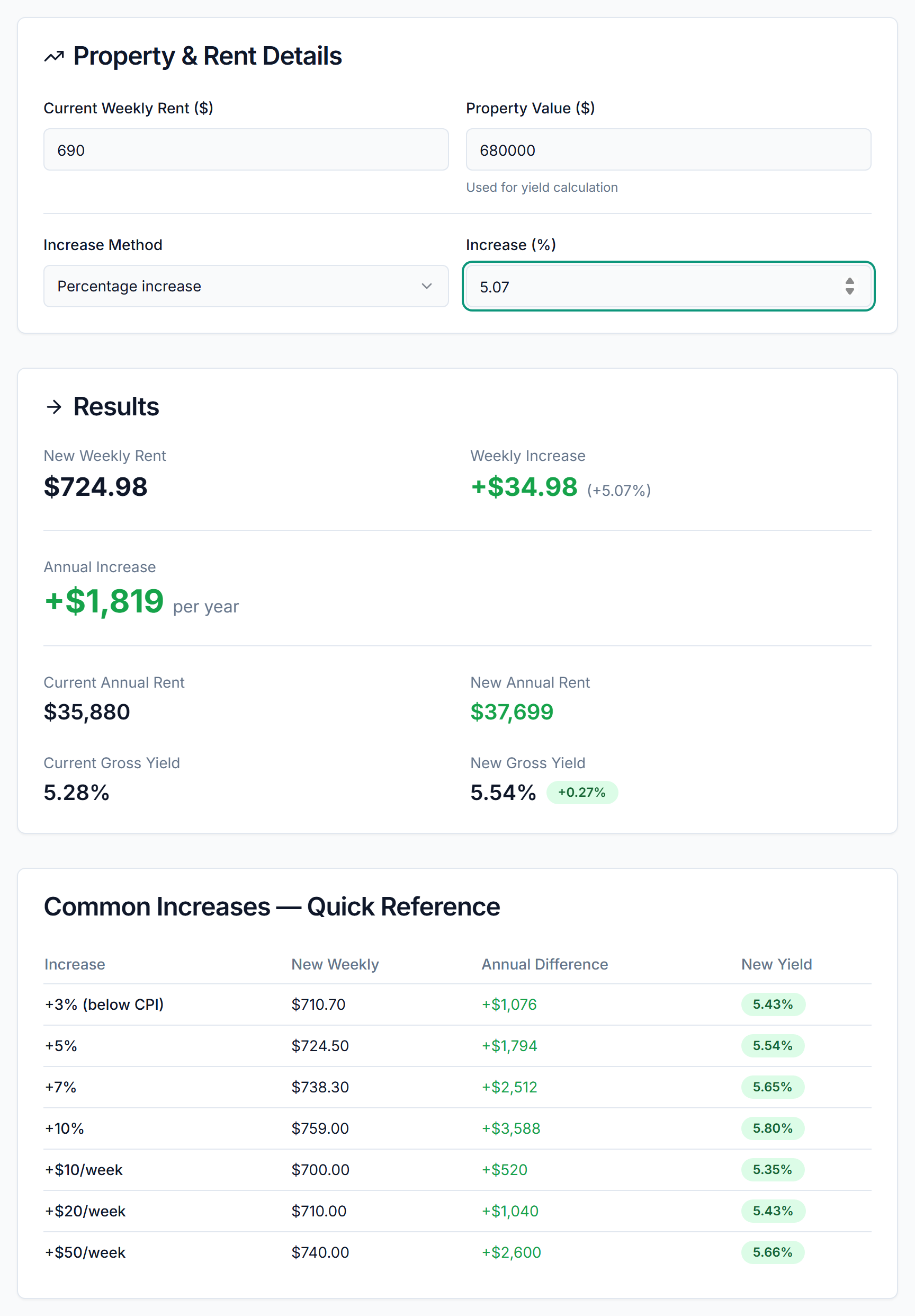
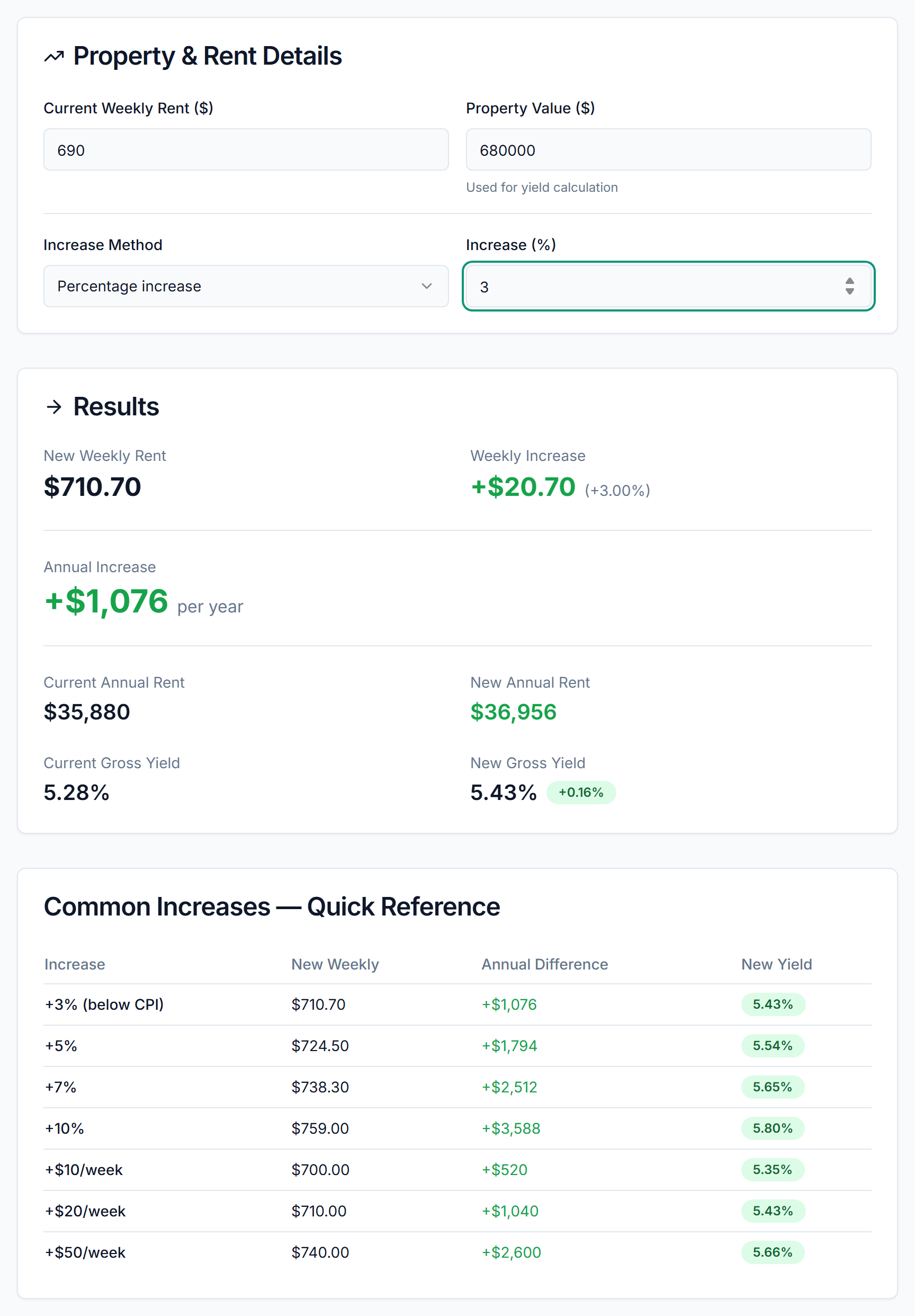
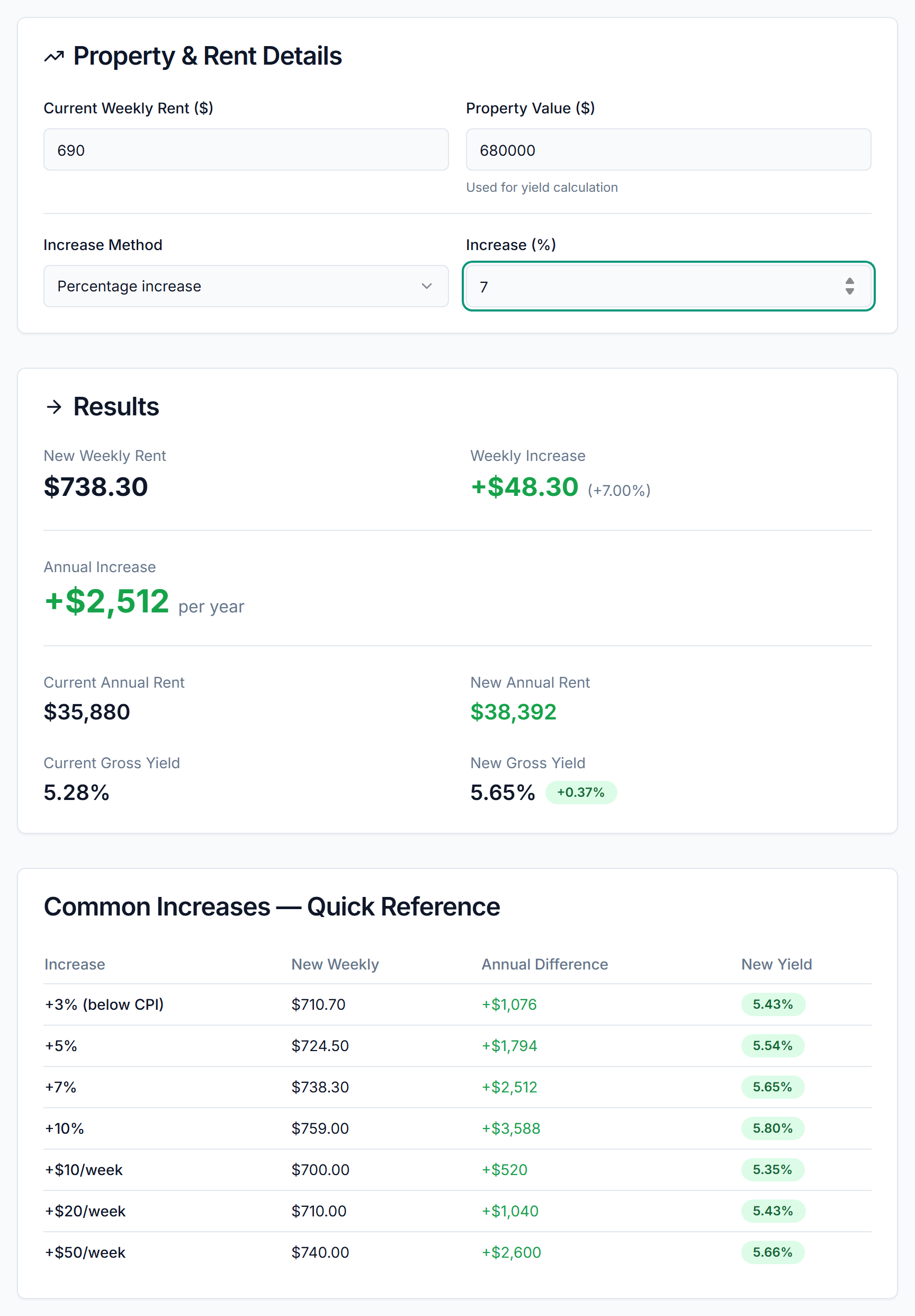
Worked Example - Brisbane Rental Review on a $680,000 Investment Property
Assume you own a three-bedroom townhouse in Chermside, Brisbane, rented at $690 per week. Your annual lease review is due, similar new listings are leasing between $720 and $740 per week, and you want to lift rent without pushing the tenant out.
| Item | Annual Amount |
|---|---|
| Current rent ($690/week x 52) | $35,880 |
| Proposed rent ($725/week x 52) | $37,700 |
| Gross annual increase | +$1,820 |
| Property management fee at 7% on new rent | -$2,639 |
| Estimated extra vacancy risk if tenant leaves (2 weeks) | -$1,450 |
| Reletting and advertising allowance | -$450 |
| Net upside if tenant stays | +$1,820 |
| Net outcome if tenant leaves immediately | -$80 |
The lesson is simple: a rent increase that looks profitable on paper can be neutral or negative if the tenant churns. The best rental managers do not just ask, "Can I raise the rent?" They ask, "What increase is both legal and economically smart?"
Run this exact scenario in the PropBoss Rental Increase Calculator before sending notice.
How Rental Property Management Works
Step 1: Set the management model
Choose whether you will self-manage or appoint a professional property manager. This decision affects cost, time, response speed, and your exposure to admin and legal mistakes.
Step 2: Set and review the rent
At lease commencement and at each review point, compare your property with similar nearby rentals. Look at weekly rent, inclusions, condition, parking, pet policy, and lease terms. Then model the proposed increase in the Rental Increase Calculator.
Step 3: Follow the state notice rules
A rent increase is not valid just because the amount is reasonable. You also need the correct notice period, format, and timing for the state or territory. This is where many owners slip up.
State-by-State Rent Increase Rules
Australia does not have one national rent increase rule. NSW, Victoria, Queensland, Western Australia, South Australia, Tasmania, the ACT, and the NT all run through their own tenancy frameworks, notice rules, and challenge processes. In practice, investors should confirm three things before every review: how often rent can be increased, how much notice is required, and which tribunal or tenancy body hears disputes.
Victoria is a good example of why this matters. Even if a rent review looks commercially reasonable, it can still be challenged at VCAT if the process or evidence is weak. Queensland investors should also confirm current guidance from the RTA, while NSW owners should check the current notice and review settings before sending any increase.
Fixed-term leases add another layer: in some situations, an increase during the fixed term must be clearly allowed for in the agreement itself. If the clause is missing or vague, the increase may fail.
Step 4: Manage ongoing operations
Once the tenancy is active, management covers rent collection, routine inspections, repair coordination, lease renewals, insurance admin, and documentation. This is also where you monitor rental-arrears risk and maintain a usable condition-report.
Step 5: Measure the result
Review more than just headline rent. Look at vacancy days, maintenance costs, management fees, arrears, and tenant retention. A slightly lower rent with stronger retention can outperform an aggressive annual increase.
Calculate the rent impact, then check the broader numbers in our Cash Flow Calculator and Rental Yield Calculator.
What a Good Rental Manager Actually Does
| Management Task | Why It Matters |
|---|---|
| Tenant screening | Reduces arrears, damage, and tribunal risk before the tenancy starts. |
| Lease setup | Ensures the lease terms, special conditions, and notices are enforceable and correctly documented. |
| Bond and trust accounting | Protects owner funds and keeps records clean, especially where a regulated trust-account is involved. |
| Rent reviews | Keeps income aligned with market conditions without creating avoidable churn. |
| Repairs coordination | Prevents minor maintenance from turning into bigger capex or tenant disputes. |
| Routine inspections | Identifies wear, unauthorised occupants, pets, and maintenance issues early. |
| Arrears follow-up | Stops small late payments becoming entrenched rental-arrears. |
| Insurance documentation | Makes landlord insurance and tribunal evidence easier if a claim arises. |
| End-of-lease management | Helps recover the property cleanly, using the entry and exit condition record correctly. |
| Record-keeping | Supports tax, dispute resolution, and year-end portfolio review. |
For EOFY admin, pair your rental management records with the PropBoss Tax Deduction Checklist.
Self-Managing vs Using a Property Manager
| Factor | Self-Managing | Using a Property Manager |
|---|---|---|
| Cost | Lower direct fees | Ongoing fee plus possible extras |
| Time commitment | High | Lower for owner |
| Legal admin | Owner handles notices, lease, disputes | Agent handles process if competent |
| Tenant communication | Direct and immediate | Filtered through agency |
| Arrears control | Depends on owner discipline | Often stronger with systems |
| Inspections and evidence | Owner responsibility | Usually included in management scope |
| Best suited for | Experienced owners with time and process | Investors scaling a portfolio or valuing time leverage |
There is no universal winner. If you own one local property, know the rules, and have time, self-management can work. If you are time-poor, interstate, or building a portfolio, the right property manager often pays for themselves through lower vacancy, better rent reviews, and fewer admin failures.
Is Rental Property Management Worth Paying For in 2026?
In many Australian markets, yes, but only if the manager is genuinely competent. Rents remain elevated in many cities, which makes each extra vacancy week expensive. At the same time, tenants are more likely to challenge sloppy increases, and compliance mistakes can delay revenue.
Professional management tends to be most valuable when:
- you own interstate property
- the property has frequent maintenance or tenant turnover
- your personal hourly rate is too high to justify DIY admin
- you want faster, better-documented rent reviews
It is less compelling when you are paying a full fee for low-service administration. A poor manager can cost you more than no manager at all if they under-rent the property, mishandle a renewal, or miss a maintenance issue that leads to damage.
The Key Factor Most Investors Miss: Rent Review Discipline
The biggest management lever in this cluster is not the fee percentage. It is rent review discipline.
Many landlords fall into one of two traps. The first is under-reviewing rent for years and leaving $20 to $80 per week on the table. The second is overcorrecting with a sudden jump that pushes a good tenant out. Both outcomes damage returns.
A disciplined rent review uses:
- comparable leased and listed evidence
- tenancy history and payment reliability
- local vacancy conditions
- CPI as a benchmark, not a rule
- the state notice and frequency rules
- a modeled turnover cost before notice is issued
That is why the PropBoss Rental Increase Calculator is more useful than a generic percentage tool. It helps frame the decision around dollars and outcomes, not instinct.
If your rent review changes the portfolio-level numbers, model the knock-on effect in the Portfolio Return Calculator.
Common Rental Management Mistakes
1. Chasing the maximum possible rent instead of the best net result
The highest advertised market rent is not always the best decision. If a strong tenant leaves and the property sits vacant, your annual return can go backwards quickly.
2. Treating notice as a formality
Incorrect notice timing or formatting can invalidate the increase. Compliance is part of the financial outcome.
3. Ignoring management fee extras
Many owners compare only the monthly percentage fee. Letting fees, statement fees, tribunal attendance, lease renewal charges, and maintenance mark-ups can materially change the real cost.
4. Weak entry and exit records
Without a strong condition-report, bond disputes and insurance claims get harder to win.
5. Late maintenance
Delaying repairs often creates larger bills, weaker tenant goodwill, and more turnover. Good management protects both the asset and the relationship.
6. No annual portfolio review
Rental management should not be handled property by property in isolation. Review rent, vacancy, yield, expenses, and maintenance trends across the portfolio each financial year.
How to Calculate a Sensible Rent Increase
Use this simple sequence before every review:
- Confirm the current weekly rent.
- Check comparable listings and recent leases nearby.
- Confirm the legal timing and notice rule for your state.
- Estimate the proposed weekly increase.
- Model tenant-retention risk and vacancy cost.
Rent review upside = Proposed annual rent - Current annual rent
Net review outcome = Rent review upside - expected vacancy cost - reletting cost - extra management cost
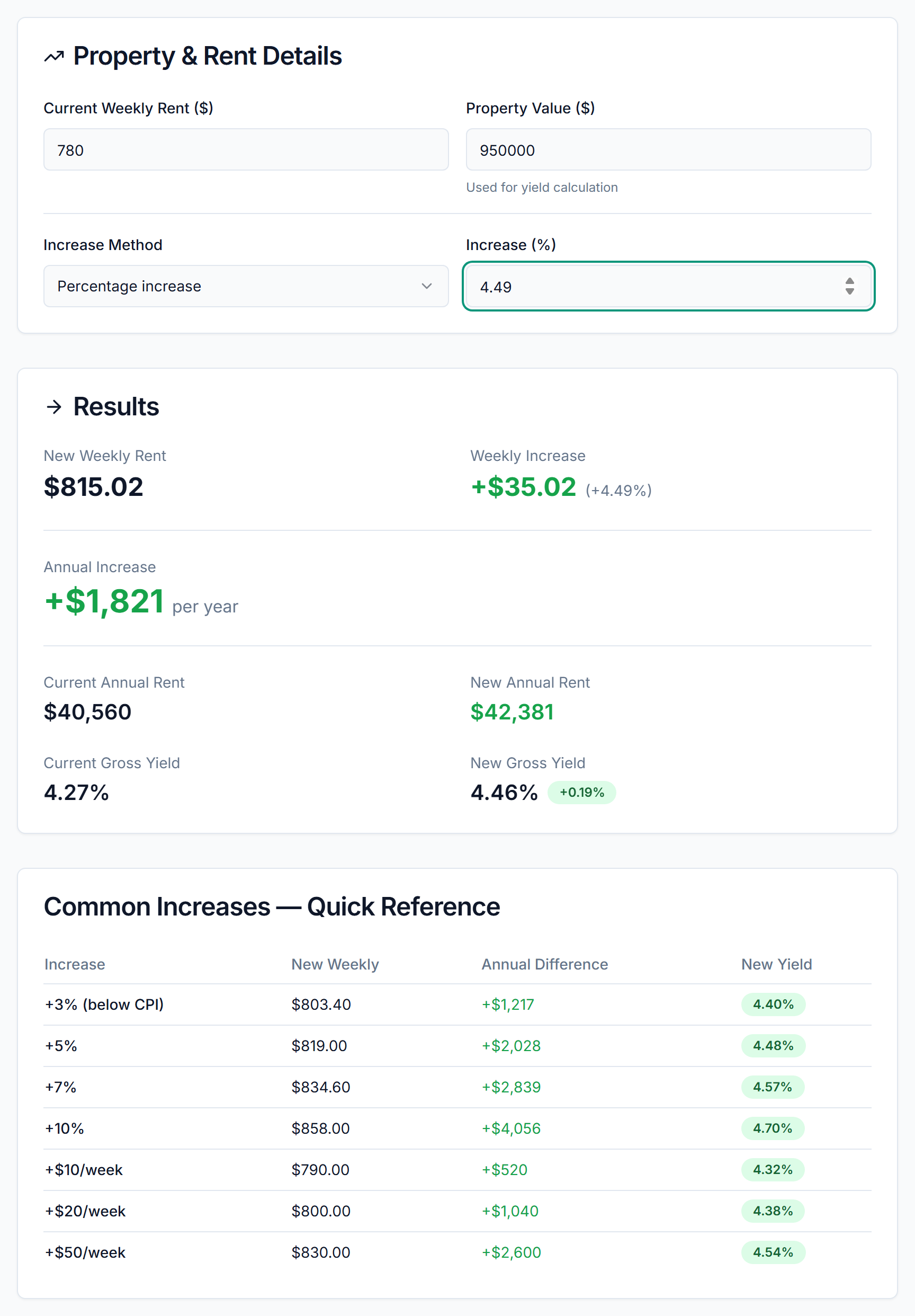
Worked Example - Sydney Unit Review
| Item | Annual Amount |
|---|---|
| Current rent ($780/week x 52) | $40,560 |
| Proposed rent ($815/week x 52) | $42,380 |
| Gross uplift | +$1,820 |
| Two-week vacancy if tenant exits | -$1,630 |
| Leasing cost and ads | -$500 |
| Net if tenant leaves | -$310 |
| Net if tenant stays | +$1,820 |
In this case, a landlord should ask whether the extra $35 per week is worth the risk of a vacancy event. Often the smarter move is a smaller increase combined with an early renewal.
Test a few scenarios with the Rental Increase Calculator, then check whether the property still fits your target return profile in the Cash Flow Calculator.
Frequently Asked Questions
What is the maximum rent increase allowed in NSW?
NSW does not apply a universal percentage cap to every private residential rent increase. What matters is whether the increase follows the current tenancy rules, the lease terms, and the required notice process. If a renter believes the increase is excessive, they can challenge it using comparable rents and the condition of the property. For investors, the practical rule is to use evidence, not guesswork.
How often can a landlord increase rent?
That depends on the state or territory and the type of agreement in place. Some jurisdictions set clear timing limits, while others focus on notice and fairness. Investors should check the current rule before each review rather than relying on old practice, especially because tenancy reforms have changed quickly in several states over the last two years.
What is the maximum rent increase allowed in Victoria?
Victoria requires the landlord or agent to follow the prescribed process and provide valid notice. The real test is whether the increase can be supported if challenged. That means comparing similar local properties, checking recent leasing activity, and documenting the reasons for the proposed figure.
What is considered an excessive rent increase?
An increase is excessive when it is materially out of line with the market and cannot be justified by the property's features, improvements, location, or rental evidence. Tribunal-style reasoning usually looks at comparable homes, recent rents in the area, condition, and timing. If the increase feels aggressive enough that you cannot defend it on paper, it is too aggressive.
How much notice is required for a rent increase?
Notice periods vary by state and sometimes by lease type. The safest process is to confirm the current rule, issue written notice in the correct format, and retain proof of service. This is one of those areas where a strong property manager earns their fee, because an invalid notice can delay the increase entirely.
What is the maximum rent increase allowed in Queensland?
Queensland focuses on whether the increase is issued at the right time, with the right notice, and on whether it is supportable if contested. Owners should compare the proposed rent with similar local listings and recent lease outcomes, not just with their own rising costs.
How much can a landlord increase rent in Australia?
There is no single national answer because tenancy law is state-based. A legal and sensible increase in one jurisdiction may be too early, too poorly documented, or too aggressive in another. Investors should think in two layers: legal compliance first, commercial judgment second.
How much do rental property management companies charge?
Residential management is commonly priced as a percentage of rent collected, often around 5% to 10% plus GST, with possible extras for letting, lease renewals, routine inspections, maintenance coordination, or tribunal attendance. Compare the full annual cost, not just the headline fee.
What is the average property management fee for rental properties?
A fair benchmark for many metro residential properties is around 6% to 8% of rent plus GST, though local competition and service scope matter. Paying slightly more for a manager who holds rent to market, keeps vacancies low, and documents everything properly can be far cheaper than paying a lower fee for weak execution.
Track Your Rental Management Automatically with PropBoss
The best rental decisions are documented, modelled, and repeatable. PropBoss helps investors track rent reviews, compare property performance, and connect rent changes back to portfolio returns.
Get Started Free
Try the Rental Increase Calculator
Related Guides & Tools
- Rental Increase Calculator - model weekly and annual rent review outcomes before you send notice.
- How Much Should You Increase Rent? A Guide for Australian Landlords - supporting cluster article on practical rent review decisions.
- Cash Flow Calculator - test how a rent increase changes annual portfolio cash flow.
- Rental Yield Calculator - check whether rent changes also improve the property's gross and net yield.
- Tax Deduction Checklist - keep landlord admin and EOFY records aligned.
- Depreciation Estimator - pair stronger rent with stronger after-tax reporting.
Methodology, Sources, and Review Context
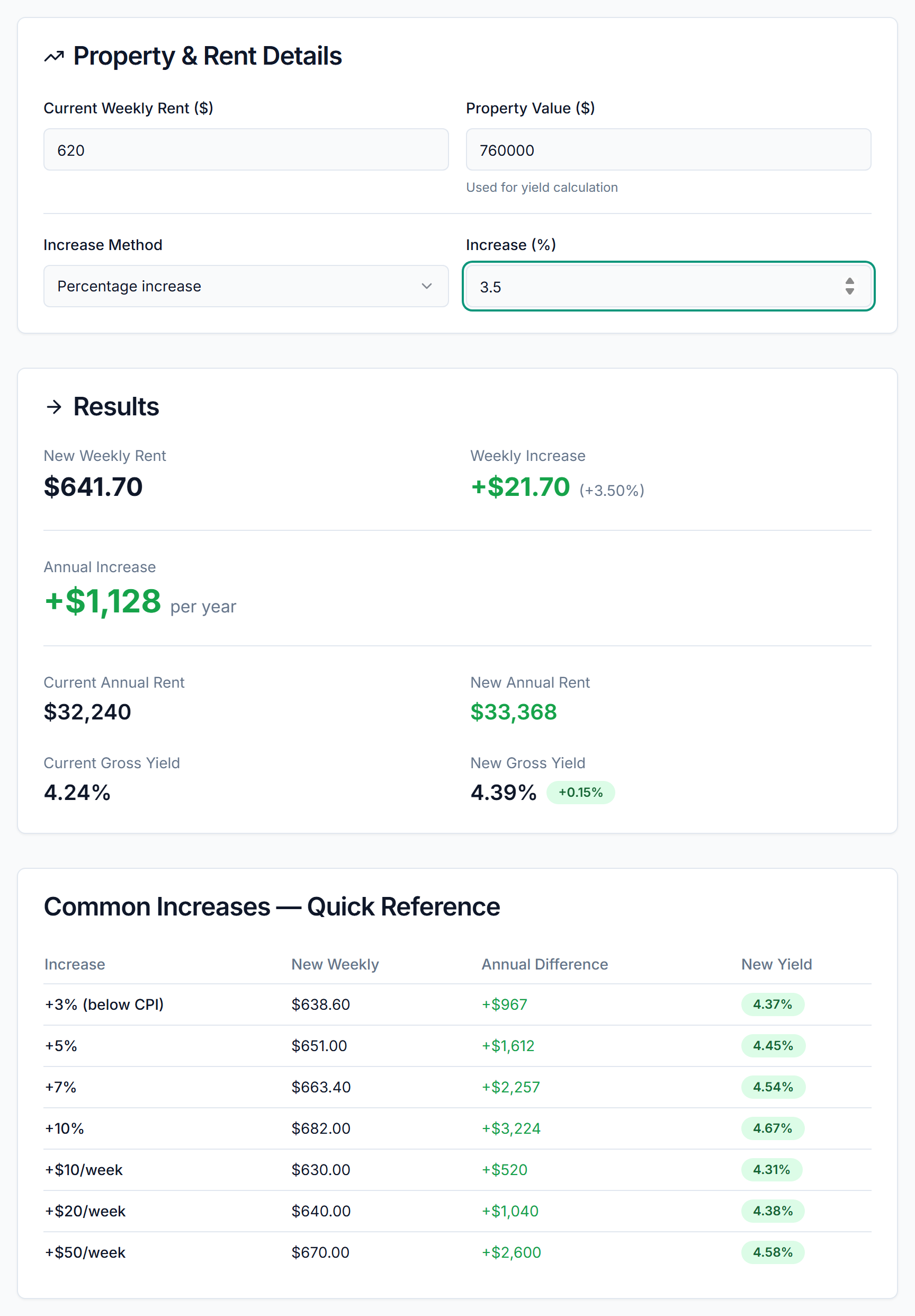
This guide was prepared using current public tenancy guidance patterns across Australian states and territories, PropBoss calculator outputs, and practical investor workflows for rent reviews, comparable rents, vacancy risk, property management costs, and record-keeping. Worked calculator screenshots were captured on 29 April 2026 from the live PropBoss Rental Increase Calculator.
Rental law changes regularly and is state-based. Use this guide as general information, then verify the current rules for the property's jurisdiction before issuing a rent increase, changing a lease term, or relying on a tribunal process. This guide does not constitute legal advice.
Reviewed in the context of PropBoss product and investor workflows by Jonathan Zuvela, founder of PropBoss.
Review the rent before you send notice
Use the calculator to model the weekly increase, annual uplift, and yield change before you lock in a rent review.